Example: AI Agent Network
This example shows Genesis Mesh as a trust fabric for internal AI agents that must prove identity before exchanging tasks or data.
        flowchart TB
    na["Network Authority"]
    supervisor["Supervisor Agent<br/>role:supervisor"]
    finance["Finance Agent<br/>role:finance"]
    crm["CRM Agent<br/>role:crm"]
    support["Support Agent<br/>role:support"]

    na -->|invite + cert| supervisor
    na -->|invite + cert| finance
    na -->|invite + cert| crm
    na -->|invite + cert| support

    supervisor <-->|Noise XX + routes| finance
    supervisor <-->|Noise XX + routes| crm
    supervisor <-->|Noise XX + routes| support
Deployment Steps
Create a signed genesis block for the agent network.
Start the Network Authority with operator keys and durable state.
Issue one invite per agent role.
Enroll each agent node with its invite token.
Start persistent node runtimes so agents can authenticate peers and exchange routes.
Certificates Issued
The Network Authority issues short-lived join certificates:
Agent |
Role |
Validity |
|---|---|---|
Supervisor |
|
Operator-defined |
Finance |
|
Operator-defined |
CRM |
|
Operator-defined |
Support |
|
Operator-defined |
Roles come from invite tokens, not client-supplied claims.
Routes Established
After Noise XX handshakes, agents announce reachable peers. The supervisor can route to individual agents, and agents can communicate through authenticated next hops when topology allows it.
Revocation Drill
If the CRM agent is compromised:
Revoke the CRM certificate with
/admin/revoke.Publish the updated signed CRL.
Peers reject new handshakes from the revoked certificate.
Existing routes from the revoked identity are withdrawn or ignored.
Re-enroll only after issuing a new invite and reviewing the key-compromise reason.
LLM-Backed Agent Flow
The same trust fabric can carry a real LLM-backed responder. The example
under examples/agent-network/llm_agent.py uses LiteLLM behind the agent
boundary: Genesis Mesh handles enrollment, peer identity, encrypted transport,
and provenance; LiteLLM handles the provider call.
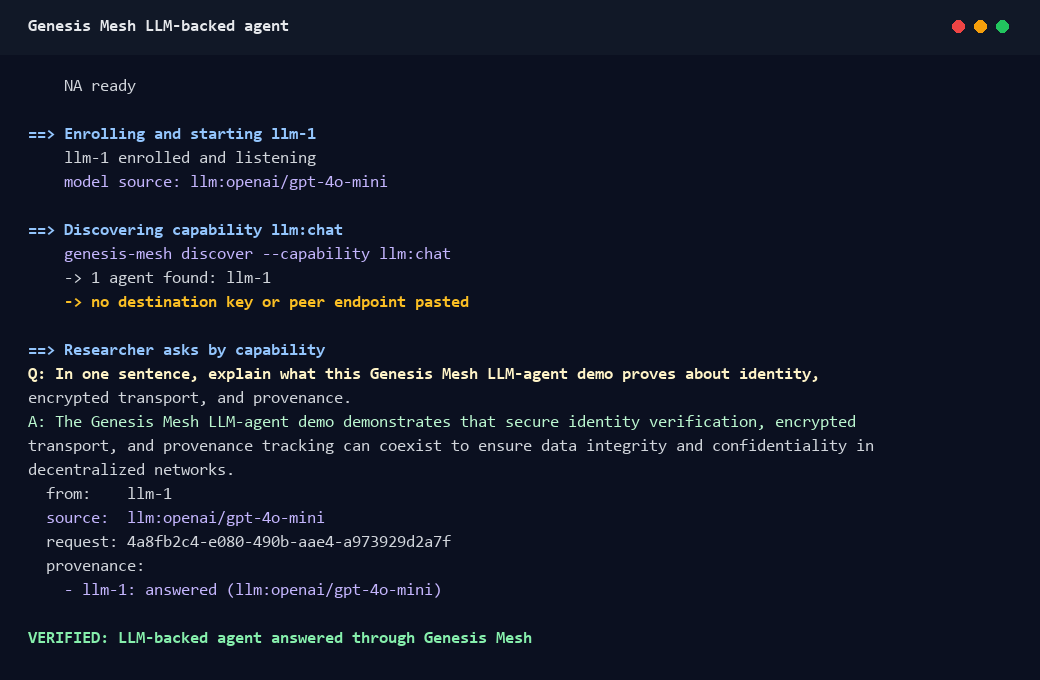
Static walkthrough:
Animated execution:
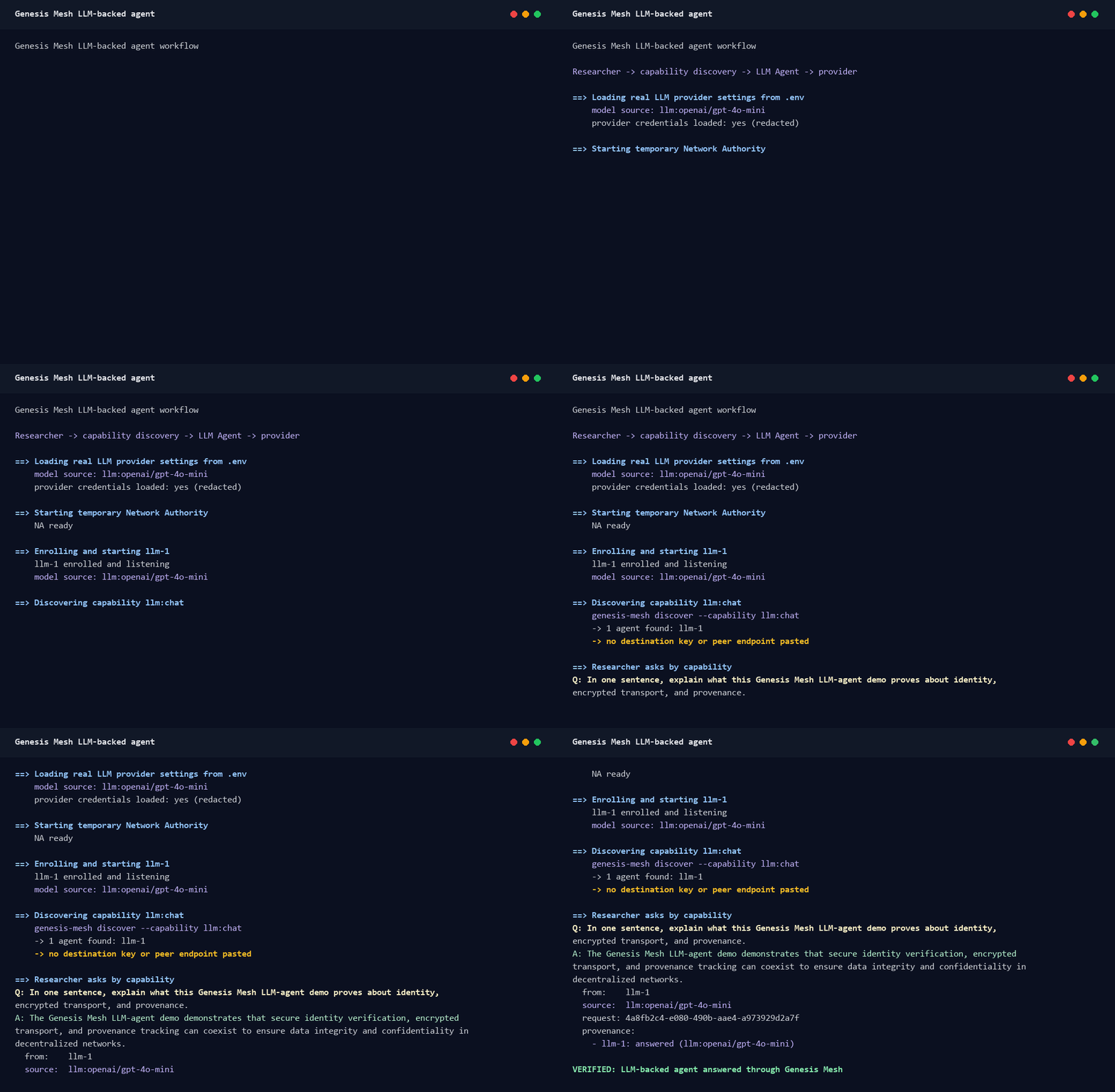
The docs recording was generated with real LLM_* provider settings loaded
from .env:
python docs\examples\assets\scripts\llm-agent-demo.py --real-llm
Run the real LLM recording with Python 3.12 or 3.13 until fixed LiteLLM releases publish Python 3.14-compatible builds. The rest of Genesis Mesh and the deterministic mock demos continue to run on Python 3.14.
The recorder discovers the agent by llm:chat capability, sends the researcher
request without a pasted destination key or peer endpoint, and never writes the
API key to the rendered assets.
Distributed Capability Orchestration
Discovery becomes more powerful when an agent composes other capabilities. The v0.8 orchestration example adds a planner capability:
Researcher
  -> planner.answer
      -> repo.summary
      -> llm.chat
  -> answer + provenance
The researcher does not configure provider node keys, peer endpoints, provider identities, or provider hosts. It discovers a planner, and the planner discovers and invokes the trusted providers.
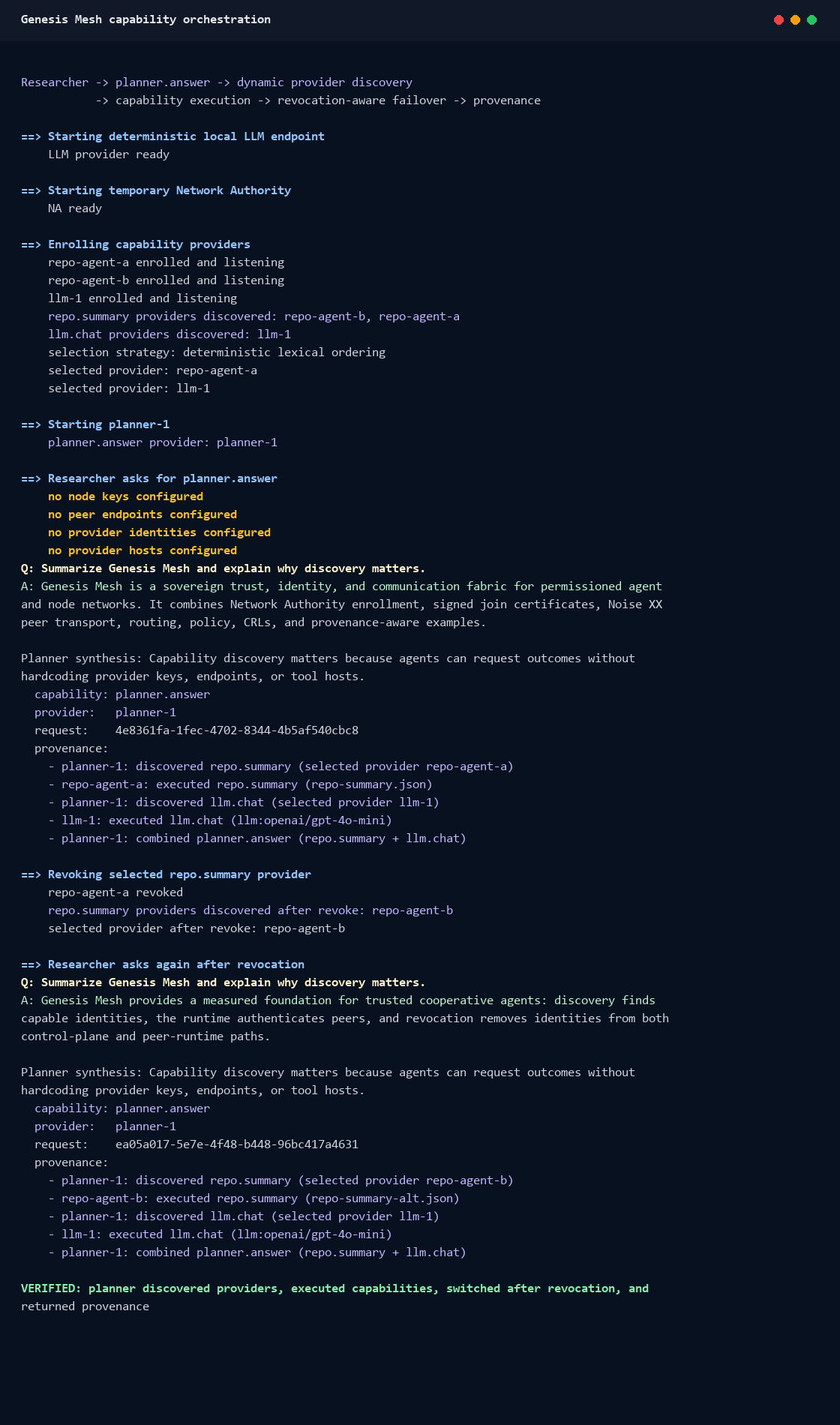
Full walkthrough: