Example: Independent Sovereigns Proof
This example proves the operational gap called out after the v0.9 through v0.12 trust-roadmap releases: the same direct-recognition and revocation protocol works across two different cloud VMs.
The proof uses one Network Authority on Azure as Sovereign A and one Network Authority on DigitalOcean as Sovereign B:
Sovereign |
Provider |
Network name |
Endpoint |
|---|---|---|---|
Sovereign A |
Azure |
|
|
Sovereign B |
DigitalOcean |
|
|
        sequenceDiagram
    participant NB as Sovereign B: USG-NB (DigitalOcean)
    participant AZ as Sovereign A: USG (Azure)
    participant F as Signed NB Revocation Feed
    participant C as Azure Connectome

    NB->>NB: Issue MembershipAttestation
    AZ->>AZ: Issue RecognitionTreaty for USG-NB
    NB-->>AZ: Present attestation
    AZ-->>NB: accepted through treaty
    NB->>NB: Revoke attestation
    NB->>F: Publish signed feed sequence 1
    AZ->>AZ: Import NB feed under treaty subject key
    NB-->>AZ: Present same attestation
    AZ-->>NB: rejected: attestation_locally_revoked
    AZ->>C: GET /connectome.json
    C-->>AZ: USG -> USG-NB edge and revocation blast radius
What This Proves
Sovereign identities are independent: Azure advertises
USG, while DigitalOcean advertisesUSG-NB.Direct recognition crosses a real network boundary between cloud providers.
Azure accepts an NB-issued membership attestation only after signing a treaty for NB’s public Network Authority key.
NB controls withdrawal of its own attestation through a signed revocation feed.
Azure imports that feed and rejects the same attestation without revoking the broader treaty.
Azure’s Connectome explains the trust path and imported revocation blast radius from the persisted graph state.
Live Recording

Static screenshot:
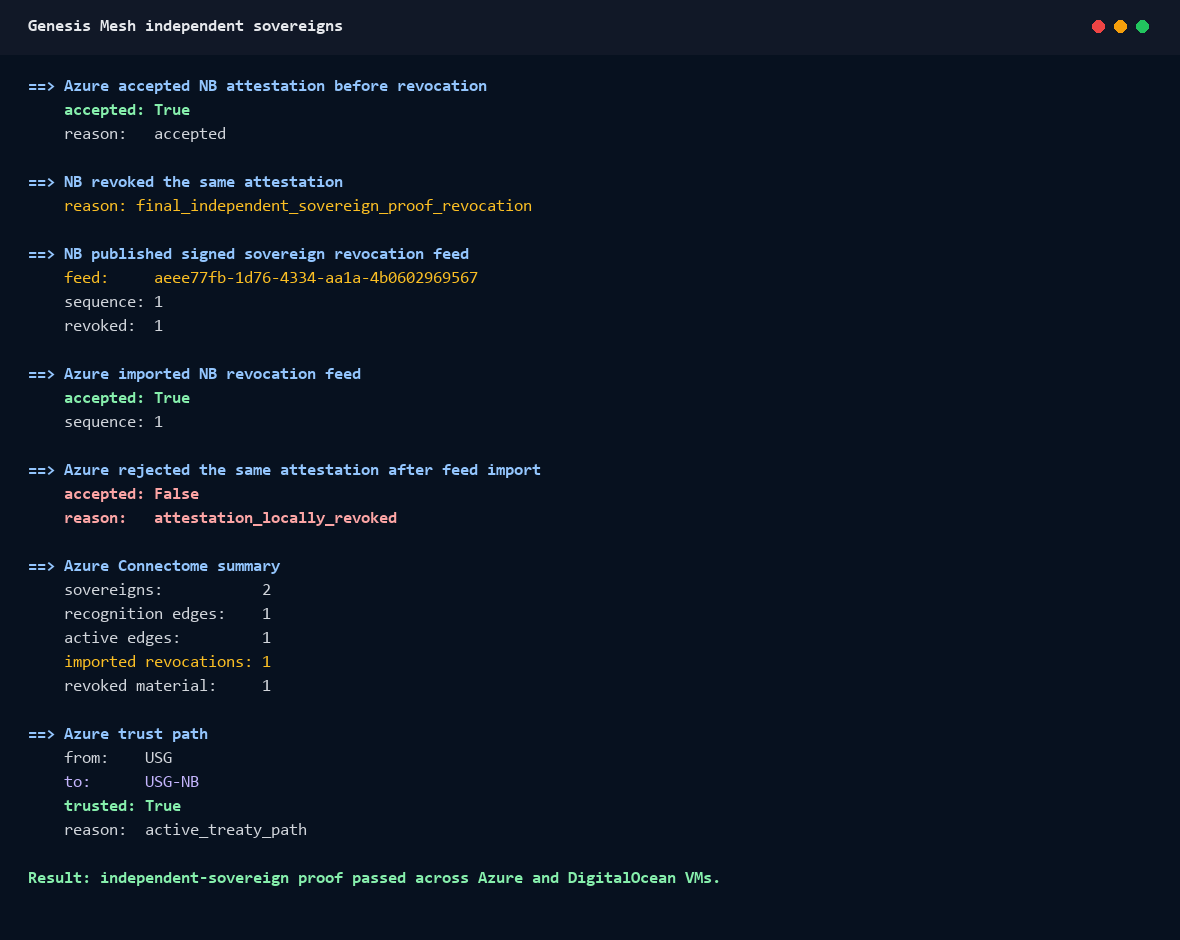
Verified Evidence
The clean proof was run from a pristine Connectome state on both authorities.
Azure: USG
DigitalOcean NB: USG-NB
Attestation: 3ee9bc08-9685-461b-8b00-ed4ff05a8c16
Treaty: 3b11b22d-a888-4c09-b6a0-f55a4161ba40
Revocation feed: aeee77fb-1d76-4334-aa1a-4b0602969567
Feed sequence: 1
Before revocation: accepted=true / accepted
After revocation import: accepted=false / attestation_locally_revoked
Trust path: USG -> USG-NB / active_treaty_path
Final Azure Connectome summary:
{
  "sovereign_count": 2,
  "recognition_edge_count": 1,
  "active_edge_count": 1,
  "imported_revocation_count": 1,
  "revoked_trust_material_count": 1
}
Run
To regenerate the documentation assets from the captured transcript:
python docs\examples\assets\scripts\independent-sovereigns-demo.py
The default command is non-mutating. It renders the verified transcript into PNG and GIF assets.
To run the live proof again against the two VMs, pass --live from a machine
that has the operator key configured:
python docs\examples\assets\scripts\independent-sovereigns-demo.py `
  --live `
  --operator-key .genesis-mesh\keys\operator.key
Live mode creates a new NB attestation, a new Azure recognition treaty, imports a new NB revocation feed, and leaves those proof artifacts in Azure’s Connectome until cleaned.
For operator workflows, the supported CLI proof runner performs the same live flow and writes a redacted proof bundle:
genesis-mesh proof remote `
  --acceptor https://na.genesismesh.connectorzzz.com `
  --issuer http://164.92.250.135:8443 `
  --operator-key .genesis-mesh\keys\operator.key `
  --operator-key-id operator-local `
  --claim proof=independent-sovereigns `
  --proof-bundle .\independent-sovereigns-proof.json
Clean State
Before capturing a clean proof, the proof tables should be empty on both authorities. Use the cleanup command while the NA service is stopped; it backs up the database first and removes only proof artifacts:
sudo systemctl stop genesis-mesh-na
genesis-mesh proof cleanup \
  --db-path /var/lib/genesis-mesh/na.db \
  --backup-dir /var/lib/genesis-mesh \
  --yes
sudo systemctl start genesis-mesh-na
The cleanup command uses Python’s SQLite library instead of the sqlite3 CLI
because minimal Ubuntu VMs do not always have the SQLite command-line tool
installed.
Expected clean Connectome:
{
  "active_treaties": [],
  "recognition_edges": [],
  "revocation_blast_radius": [],
  "revoked_trust_material": [],
  "sovereigns": [],
  "summary": {
    "active_edge_count": 0,
    "imported_revocation_count": 0,
    "recognition_edge_count": 0,
    "revoked_edge_count": 0,
    "revoked_trust_material_count": 0,
    "sovereign_count": 0
  }
}
Operational Meaning
The roadmap releases proved the protocol in maintainer-operated demos. This independent-sovereign proof shows the same mechanism crossing from protocol proof to operational proof: separate VMs, separate databases, separate genesis identities, separate Network Authority keys, and a real cloud-provider network boundary.
This is still not multi-cloud operation proof. Adoption begins when external operators run their own sovereigns and create recognition edges that do not depend on the maintainer operating both sides.