Example: Relationship Agreement
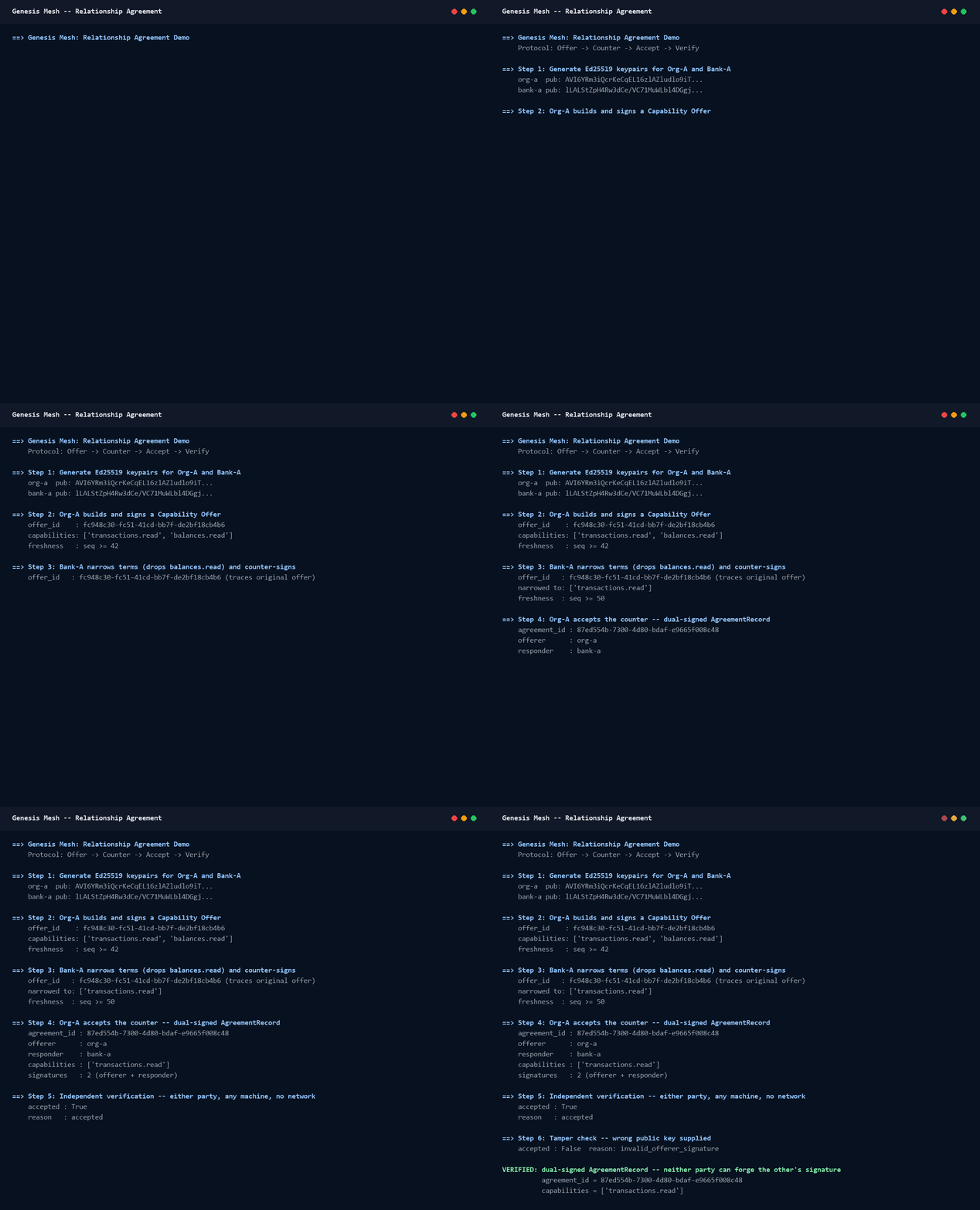
A Relationship Agreement is how two sovereign parties — each possessing portable trust material in the form of treaties, feeds, and identity proofs — produce a shared, signed record that governs future interactions.
Existing systems let one party decide what another may do. Genesis Mesh lets two sovereign parties produce a shared, signed agreement describing the relationship under which future interactions occur.
The protocol is: Offer → Counter-offer (optional) → Acceptance.
        sequenceDiagram
    participant A as Org-A (offerer)
    participant B as Bank A (responder)

    A->>A: evaluate trust → offerer_evidence
    A->>B: CapabilityOffer (signed by A)
    B->>B: evaluate trust → responder_evidence
    B->>A: CapabilityCounter (signed by B, narrower terms)
    A->>A: accept counter → AgreementRecord (signed by A)
    note over A,B: AgreementRecord already carries B's counter sig<br/>(counter and agreement share canonical form)
    A-->>B: AgreementRecord (dual-signed)
What This Proves
Neither party can produce the
AgreementRecordalone — it requires two independent Ed25519 signatures over the same canonical JSON.Both parties agreed to the same specific terms: capabilities, scope, validity window, and freshness commitment.
The agreement is bound to a specific recognition-graph state via
graph_digest.Independent
TrustEvidencerecords from both directions are embedded.The record is valid regardless of how the files were exchanged (email, API, USB drive, Noise XX session).
Agreements evaluate existing rights. They never create new rights. Terms can only be a subset of what existing treaties permit.
Prerequisites
Two sovereigns (Org-A and Bank A) each holding:
A recognition-graph export (from
/recognition-graph)An Ed25519 operator private key
An active treaty toward the other party
Flow A: Offer → Counter-offer → Acceptance (recommended)
1. Org-A builds and signs an Offer
genesis-mesh trust agree offer \
    --from org-a \
    --to bank-a \
    --capability transactions.read \
    --capability balances.read \
    --scope '{"delegation": false}' \
    --valid-until 2027-01-01T00:00:00Z \
    --graph org-a-graph.json \
    --signing-key org-a.key --key-id org-a-2026 \
    --output offer.json
Org-A sends offer.json to Bank A.
2. Bank A builds a Counter-offer
Bank A is willing to offer transactions.read but not balances.read:
genesis-mesh trust agree counter \
    --offer offer.json \
    --capability transactions.read \
    --freshness-floor 12 \
    --graph bank-graph.json \
    --signing-key bank.key --key-id bank-2026 \
    --output counter.json
Bank A sends counter.json back to Org-A.
3. Org-A accepts the Counter-offer
genesis-mesh trust agree accept \
    --counter counter.json \
    --offer offer.json \
    --signing-key org-a.key --key-id org-a-2026 \
    --output agreement.json
The result is a dual-signed AgreementRecord. No additional step is needed
because the counter and agreement share the same canonical JSON form — Bank A’s
counter signature is valid over the agreement.
4. Either party verifies
genesis-mesh trust agree verify \
    --agreement agreement.json \
    --offerer-public-key <org-a-pub-b64> \
    --responder-public-key <bank-pub-b64> \
    --graph org-a-graph.json
Expected output:
[OK] accepted
Agreement : <uuid>
From      : org-a
To        : bank-a
Digest    : bound
Exit code 0.
Flow B: Offer → Direct Acceptance (no counter)
When the responder accepts all offered terms without modification:
# Responder accepts the offer directly
genesis-mesh trust agree accept \
    --offer offer.json \
    --graph bank-graph.json \
    --signing-key bank.key --key-id bank-2026 \
    --output half-agreement.json

# Offerer adds their co-signature to finalize
genesis-mesh trust agree cosign \
    --agreement half-agreement.json \
    --signing-key org-a.key --key-id org-a-2026 \
    --output agreement.json
Direct acceptance requires two commands because the offerer’s original offer
signature was over the offer’s canonical form (which does not include the
responder’s evidence), not the agreement’s canonical form. The cosign step
adds the offerer’s signature over the final agreement canonical form.
AgreementRecord structure
The signed artifact carries everything needed for independent verification:
AgreementRecord
  agreement_id        — unique to this agreement
  offer_id            — traces back to the original CapabilityOffer
  offerer_sovereign_id
  responder_sovereign_id
  agreed_terms
    capabilities      — what was agreed (subset of treaty permissions)
    scope             — operator-defined constraints
    valid_from        — capability window start
    valid_until       — capability window end
    freshness_commitment  — minimum revocation-feed sequence
  offerer_evidence    — TrustEvidence (offerer→responder), embedded signed
  responder_evidence  — TrustEvidence (responder→offerer), embedded signed
  graph_digest        — SHA-256 of offerer's recognition graph
  established_at      — when the agreement was established
  expires_at          — agreement validity ceiling
  signatures          — Ed25519 signatures from both parties
Failure cases
Counter capabilities wider than offer:
build_counter raises an error and exits non-zero. Counter terms can only
narrow the offer, never widen it.
Wrong public key on verify:
trust agree verify exits 1 with [FAIL] invalid_offerer_signature or
[FAIL] invalid_responder_signature.
Half-signed agreement (verify before cosign):
trust agree verify exits 1 with [FAIL] missing_offerer_signature or
[FAIL] missing_responder_signature.
Graph state changed since agreement:
trust agree verify --graph exits 1 with [FAIL] graph_digest_mismatch.
Revocation-pressure escalation visible:
If the offerer’s TrustEvidence inside the offer shows verdict escalate, the
agreement still forms — escalation is advisory, not a blocker. The escalate
verdict is embedded in the AgreementRecord for downstream inspection. It is
never silently promoted to allow.
What the AgreementRecord does NOT prove
That a new treaty exists. Agreements evaluate existing treaties; they never create them.
That capabilities exceed treaty scope. The embedded TrustEvidence records reflect only what existing treaties permit.
That trust is unconditionally established. Either party may revoke trust material after signing; a current AgreementRecord does not override a subsequent revocation.
That execution is authorised. The AgreementRecord establishes a Relationship Agreement; it does not activate execution. That is the Relationship Context layer (future — see the forward roadmap in
ops/plan-v0.26.0.md).
See also
Example: Trust Evidence — produce the signed TrustEvidence that gets embedded in offers and counters
Example: Connectome Operator View — inspect the recognition graph that underpins the agreement
Example: Trust Atlas — visualise which relationships have active agreements