Example: Distributed Capability Orchestration
This example is the v0.8 target workflow. It proves that Genesis Mesh can orchestrate capabilities across the mesh, not only discover and message agents.
The researcher requests an outcome:
planner.answer
The planner discovers providers dynamically:
repo.summary
llm.chat
Then the planner invokes those providers, combines the results, and returns an answer with complete provenance.
The top-level proof is:
Researcher
  -> planner.answer
  -> dynamic provider discovery
  -> capability execution
  -> revocation-aware failover
  -> provenance
        sequenceDiagram
    participant Researcher as Researcher
    participant NA as Network Authority
    participant Planner as Planner agent
    participant RepoA as Repo provider A
    participant RepoB as Repo provider B
    participant LLM as LLM provider

    Researcher->>NA: GET /agents?capability=planner.answer
    NA-->>Researcher: planner-1 descriptor
    Researcher->>Planner: CapabilityRequest(planner.answer)

    Planner->>NA: GET /agents?capability=repo.summary
    NA-->>Planner: repo-agent-a, repo-agent-b
    Planner->>Planner: Select repo-agent-a deterministically
    Planner->>RepoA: CapabilityRequest(repo.summary)
    RepoA-->>Planner: CapabilityResponse(summary, provenance)

    Planner->>NA: GET /agents?capability=llm.chat
    NA-->>Planner: llm-1
    Planner->>LLM: CapabilityRequest(llm.chat)
    LLM-->>Planner: CapabilityResponse(answer, provenance)

    Planner->>Planner: Combine summary + LLM answer
    Planner-->>Researcher: CapabilityResponse(planner.answer, provenance)
What This Proves
The requester asks for a capability, not a node key.
The requester does not configure a peer endpoint.
The planner does not configure provider identities or provider hosts.
Multiple providers can be discovered for the same capability.
Provider selection is deterministic.
Revoking the selected provider causes re-discovery and alternate-provider selection.
The final answer contains a provenance chain for discovery, execution, and combination.
Static Walkthrough
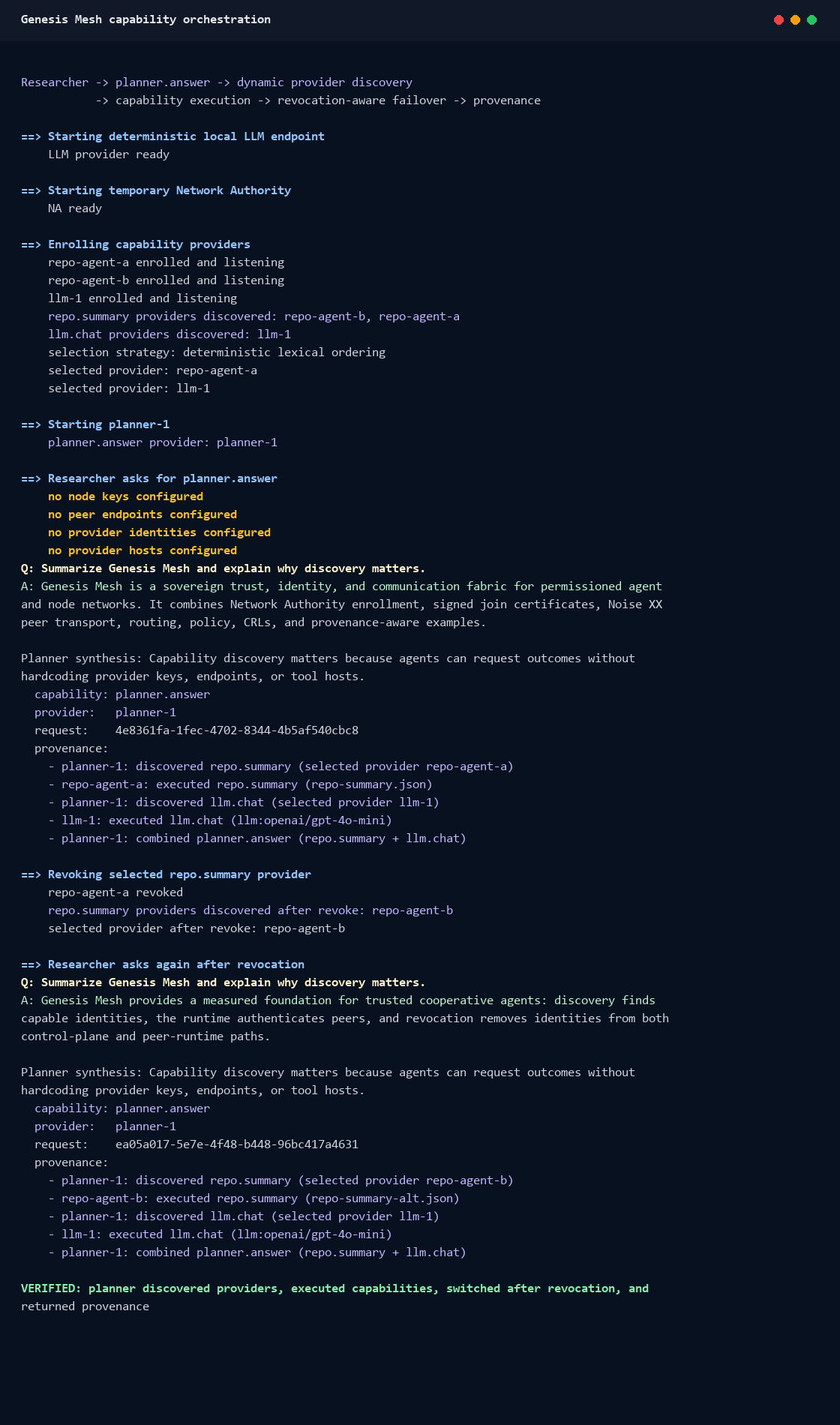
Animated Execution

Run Locally
From the repository root:
python docs\examples\assets\scripts\capability-orchestration-demo.py
For a faster verification pass without regenerating images:
python docs\examples\assets\scripts\capability-orchestration-demo.py --no-gif
The default recorder uses a deterministic local OpenAI-compatible mock so the
docs output is stable. To exercise the same flow against real provider settings,
set LLM_MODEL and LLM_API_KEY in .env or the environment and run:
python docs\examples\assets\scripts\capability-orchestration-demo.py --real-llm
The script starts:
a temporary Network Authority;
two
repo.summaryproviders;one
llm.chatprovider backed by a deterministic OpenAI-compatible mock;one
planner.answerprovider;one researcher that asks only for
planner.answer.
The requester knows only the desired capability. All provider discovery and selection occur dynamically at runtime.
Provider selection is deterministic in this demo. When multiple providers
advertise the same capability, the planner sorts by provider identity and picks
the first live provider. That is why repo-agent-a is selected even when
discovery returns repo-agent-b before repo-agent-a; capability and provider
are intentionally separate concepts.
The recorder makes that rule explicit:
repo.summary providers discovered:
  repo-agent-b
  repo-agent-a

selection strategy:
  deterministic lexical ordering

selected provider:
  repo-agent-a
Expected Proof
==> Researcher asks for planner.answer
    no node keys configured
    no peer endpoints configured
    no provider identities configured
    no provider hosts configured

Q: Summarize Genesis Mesh and explain why discovery matters.
A: Genesis Mesh is a sovereign trust, identity, and communication fabric for permissioned agent and node networks...

  capability: planner.answer
  provider:   planner-1
  provenance:
    - planner-1: discovered repo.summary (selected provider repo-agent-a)
    - repo-agent-a: executed repo.summary (repo-summary.json)
    - planner-1: discovered llm.chat (selected provider llm-1)
    - llm-1: executed llm.chat (llm:openai/gpt-4o-mini)
    - planner-1: combined planner.answer (repo.summary + llm.chat)
Files
The runnable example lives under examples/agent-network/.
File |
Purpose |
|---|---|
|
Agent and capability request/response envelopes |
|
Provider interface, registry, and deterministic selection |
|
Read-only |
|
LLM-backed |
|
|
|
One-shot requester that discovers and invokes capabilities |
|
Deterministic repository summary fixture |
|
Alternate repository summary provider fixture |
Boundary
This example does not implement an MCP clone, a service catalog, autonomous planning, long-running workflow state, or write-capable tools. It intentionally keeps the v0.8 primitive small:
Identity -> Discovery -> Execution -> Orchestration -> Provenance