Example: Data Usage Attestation Layer
Sovereign agents that access data — model weights, training datasets, proprietary logs — must be able to prove what they accessed, how, and under which license. Without machine-verifiable attestation, an operator cannot audit post-hoc whether an agent respected a usage restriction.
v0.47 introduces a signed attestation layer for data access:
DataLicensePolicy: operator-issued allowlist of sources, access types, and volume caps.DataAccessIntent: agent-signed pre-execution declaration.DataAccessRecord: agent-signed post-execution record.DataUsageGate:BoundaryEnginegate that blocks execution before the intent clears the policy.
Out of scope: Payment, royalty calculation, and external settlement are not part of this layer.
DataAccessRecordis an attestation artefact; downstream systems decide what, if anything, to charge.
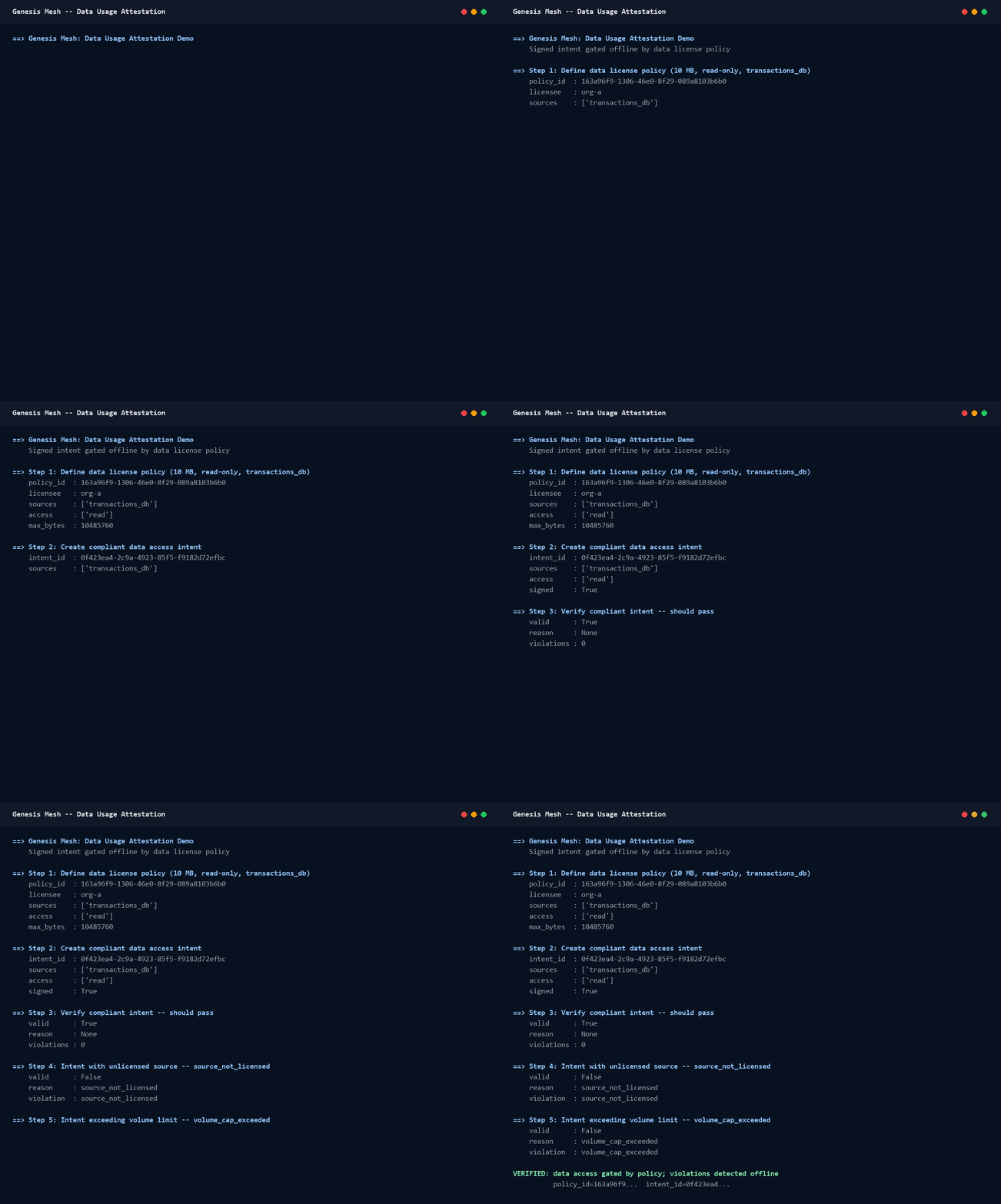
Step 1 — Create a license policy
The data licensor (e.g., the operator or data owner) defines which sources the agent may use:
genesis-mesh trust data policy \
    --licensor-sovereign operator-1 \
    --licensee-sovereign agent-a \
    --allow-source model-weights-v3 \
    --allow-source audit-logs-2026 \
    --allow-access read \
    --max-volume-bytes 104857600 \
    --signing-key keys/operator.key \
    --output policy.json
The policy is Ed25519-signed by the licensor and serialised to policy.json.
Step 2 — Declare intent before execution
Before the agent accesses any data it creates a signed intent:
genesis-mesh trust data intent \
    --agent-sovereign agent-a \
    --decision-id dec-abc123 \
    --source "model-weights-v3:proprietary:operator-1" \
    --access-type read \
    --volume-bytes 52428800 \
    --valid-for-seconds 600 \
    --signing-key keys/agent.key \
    --output intent.json
Step 3 — Verify intent against the policy
genesis-mesh trust data verify \
    --intent  intent.json \
    --policy  policy.json \
    --public-key "$(cat keys/agent.pub)"
Output on success:
[OK] compliant — <intent-id>
If the intent declares a source not listed in allowed_source_ids, or uses a
prohibited classification tag, or exceeds the volume cap, the command exits 1
and prints a detailed violation list.
Step 4 — Create a record after execution
After the access completes the agent signs a post-execution record:
genesis-mesh trust data record \
    --intent intent.json \
    --source "model-weights-v3:proprietary:operator-1" \
    --access-type read \
    --volume-bytes 48234496 \
    --signing-key keys/agent.key \
    --output record.json
The record links back to intent_id so auditors can cross-reference pre- and
post-execution attestations.
Violation types
|
Meaning |
|---|---|
|
Source not in |
|
Access type not in |
|
Source has a tag listed in |
|
Declared or actual volume exceeds |
|
|
|
|
|
Missing or invalid signature on intent / record |
Using DataUsageGate in a BoundaryEngine
from genesis_mesh.trust.data_usage import DataUsageGate, create_data_access_intent
from genesis_mesh.trust.boundary import BoundaryEngine

intent = create_data_access_intent(
    agent_sovereign_id="agent-a",
    decision_id=boundary_decision.decision_id,
    sources=[source_descriptor],
    access_types=["read"],
    signing_key=agent_sk,
    estimated_volume_bytes=50_000_000,
)

engine = BoundaryEngine(
    decision=boundary_decision,
    gates=[DataUsageGate(intent, policy, [agent_pub_b64])],
)
result = engine.evaluate(context_record)
The gate returns GateResult(passed=True, detail="compliant") or
GateResult(passed=False, detail="<violation_reason>"). The engine fails
closed — any gate failure produces a block verdict.