Example: Communication Privacy Layer
LLM-powered deanonymization (SALA — Stylometry-Assisted LLM Analysis) is now routine: stylometric features integrated with LLM reasoning can identify individuals from a handful of messages. At the Genesis Mesh network layer, every agent communication carries implicit fingerprints that SALA can exploit even when message content is encrypted:
Message length distributions — characteristic of specific agents
Timing correlation — agents that consistently respond within N milliseconds
Header metadata — custom fields, routing identifiers, encoding preferences
Structural patterns — JSON key ordering, nesting depth, array conventions
v0.43 introduces a CommunicationPrivacyProfile that normalizes message
structure, timing, and metadata before forwarding.
Scope: Structural and metadata normalization only. Content-level stylometric rewriting (e.g. paraphrasing outputs with a different writing style) requires an LLM-in-the-loop service and is explicitly out of scope.
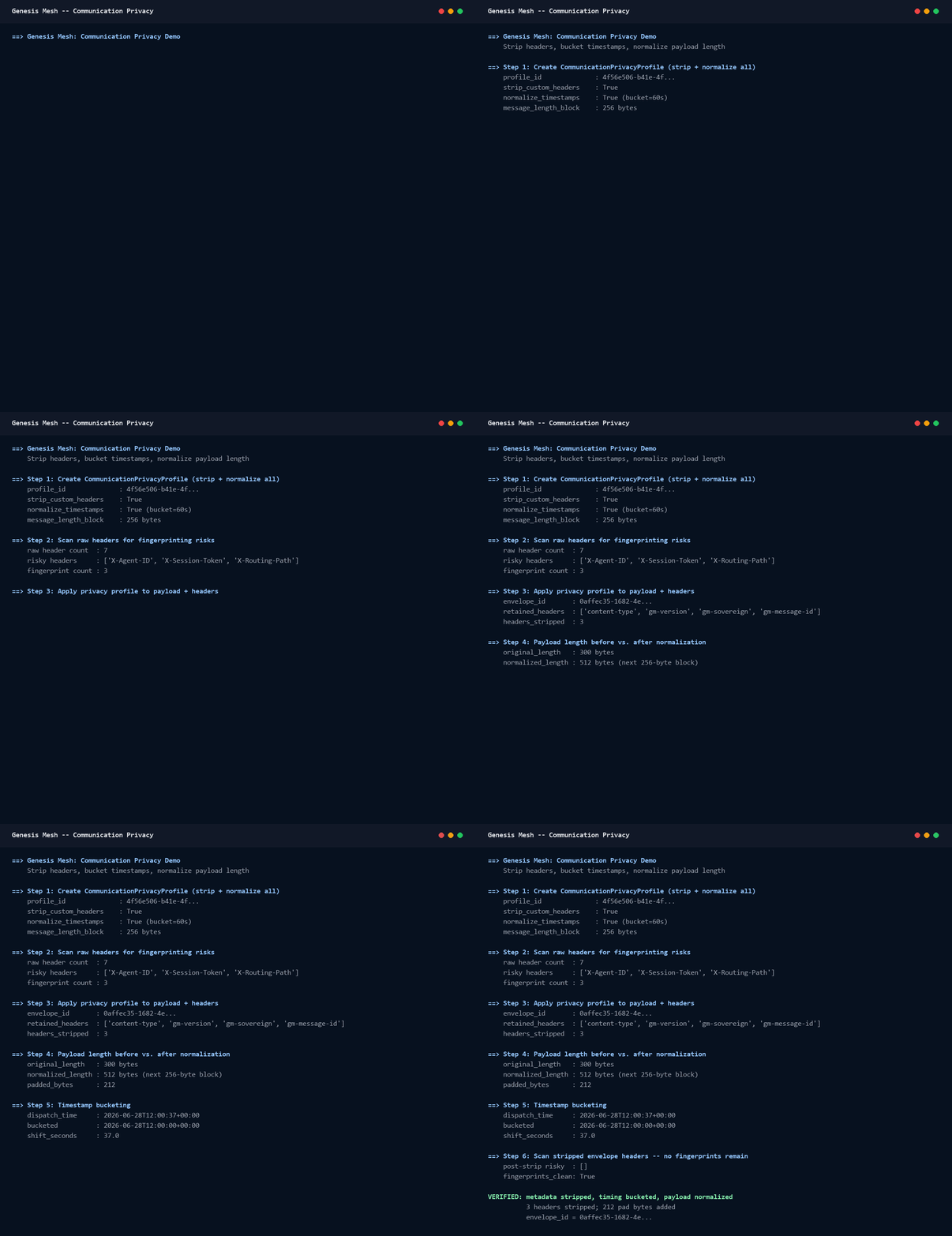
What the privacy profile normalizes
Attack vector |
Defense |
|---|---|
Custom header metadata |
Strip all headers not in |
Exact dispatch timestamp |
Round to nearest |
Payload length fingerprint |
Pad (never truncate) to nearest |
Routing metadata |
|
Step 1 — Create a CommunicationPrivacyProfile
genesis-mesh trust privacy profile \
    --sovereign-id agent-a \
    --bucket-seconds 5 \
    --block-bytes 256 \
    --signing-key keys/agent.key \
    --output profile.json
Example output:
[OK] CommunicationPrivacyProfile 3b7e9f12-...
     Sovereign      : agent-a
     Bucket seconds : 5
     Block bytes    : 256
     Strip headers  : True
     Output         : profile.json
Allow specific headers to pass through:
genesis-mesh trust privacy profile \
    --sovereign-id agent-a \
    --allow-header x-correlation-id \
    --allow-header x-request-id \
    --bucket-seconds 10 \
    --block-bytes 512 \
    --signing-key keys/agent.key \
    --output profile.json
Step 2 — Scan headers before sending
Identify which headers would be stripped before committing to a send:
genesis-mesh trust privacy scan \
    --headers outbound-headers.json \
    --profile profile.json
[WARN] 3 header(s) would be stripped:
  - x-agent-model
  - x-timing-hint
  - x-routing-path
This is non-blocking — use it for audit logging or pre-flight checks.
Step 3 — Apply the profile to an outbound message
genesis-mesh trust privacy apply \
    --payload message.bin \
    --headers outbound-headers.json \
    --profile profile.json \
    --signing-key keys/agent.key \
    --output-envelope envelope.json \
    --output-payload normalized.bin
[OK] MetadataEnvelope 9a4c2f81-...
     Original length  : 380 bytes
     Normalized length: 512 bytes
     Padded           : 132 bytes
     Headers stripped : 3
     Timestamp shift  : 2.0s
     Envelope output  : envelope.json
The normalized.bin file contains the padded payload. The envelope.json
contains the signed MetadataEnvelope with:
payload_hash— SHA-256 of the normalized payloadnormalized_length— after paddingbucketed_timestamp— rounded to bucket boundaryretained_headers— only allowed keys
Use in code
from genesis_mesh.trust.privacy import apply_privacy_profile, scan_metadata_fingerprints
from genesis_mesh.models.privacy import CommunicationPrivacyProfile
from datetime import datetime, timezone

profile = CommunicationPrivacyProfile(
    sovereign_id="agent-a",
    timestamp_bucket_seconds=5,
    message_length_block_bytes=256,
    allowed_header_keys=["x-correlation-id"],
)

# Pre-flight scan
strippable = scan_metadata_fingerprints(outbound_headers, profile)
if strippable:
    logger.info("Stripping %d fingerprint headers: %s", len(strippable), strippable)

# Apply
envelope, normalized_payload, audit = apply_privacy_profile(
    payload=message_bytes,
    headers=outbound_headers,
    dispatch_time=datetime.now(timezone.utc),
    sender_sovereign_id="agent-a",
    profile=profile,
    signing_key=agent_signing_key,
)
Timestamp bucketing
from genesis_mesh.trust.privacy import bucket_timestamp
from datetime import datetime, timezone

ts = datetime(2026, 10, 1, 10, 0, 3, tzinfo=timezone.utc)
bucketed = bucket_timestamp(ts, bucket_seconds=5)
# bucketed == datetime(2026, 10, 1, 10, 0, 0, tzinfo=timezone.utc)
Two messages dispatched at 10:00:01 and 10:00:04 both bucket to 10:00:00. An adversary cannot distinguish which was first or compute the gap.
Length normalization
from genesis_mesh.trust.privacy import normalize_payload_length

msg = b"Hello, World!"              # 13 bytes
padded = normalize_payload_length(msg, block_bytes=256)
# len(padded) == 256 (padded with zero-bytes)

aligned = b"A" * 256                # already aligned
same = normalize_payload_length(aligned, block_bytes=256)
# same == aligned (no extra block added)
Never truncates: padding only adds bytes, never removes them. This preserves the original payload intact within the padded output.
GM-required headers (always retained)
The following headers are required for Genesis Mesh protocol operation and are never stripped regardless of profile settings:
gm-versiongm-sovereigngm-message-id
What the privacy layer does NOT protect against
Content-level fingerprinting: the semantic content of messages is not rewritten. An adversary with access to the decrypted payload can still analyze writing style.
Traffic volume analysis: the privacy layer normalizes individual message metadata but does not introduce cover traffic or mix networks.
Correlation via timing at scale: bucketing reduces timing resolution; it does not eliminate correlation when message volume is high.
Adversaries with access to both endpoints: end-to-end timing correlation from sender and receiver is not addressed by metadata normalization.
See also
CLI Reference —
genesis-mesh trust privacyreferenceExample: Verifiable Logic Attestation — attestation of the execution context
Example: Context-Injection Defense Gate — protection against runtime content injection