Example: Sovereign Overlay Discovery
Genesis Mesh currently requires knowing a peer’s endpoint in advance — either via direct operator configuration or via a Network Authority acting as a central service registry. Both mechanisms share a structural vulnerability: DNS.
DNS resolves domain names to IP addresses but does not attest to cryptographic identity, capability scope, or operator authorization. ISP-level blocking and redirection can silently reroute sovereign traffic. There is no DNS-native mechanism to verify that a discovered endpoint corresponds to the expected signing key. Sub-second agentic interactions cannot tolerate DNS round-trip latency for capability verification.
v0.44 implements a peer-to-peer overlay discovery layer. Once connected to ANY peer in the mesh via Noise XX, a sovereign can discover all others without DNS. Discovery records are Ed25519-signed, providing cryptographic proof that the endpoint belongs to the identity.
Bootstrap caveat: A sovereign still needs at least one hard-coded or manually-configured bootstrap peer to enter the mesh. After first contact, DNS is no longer required for discovery.
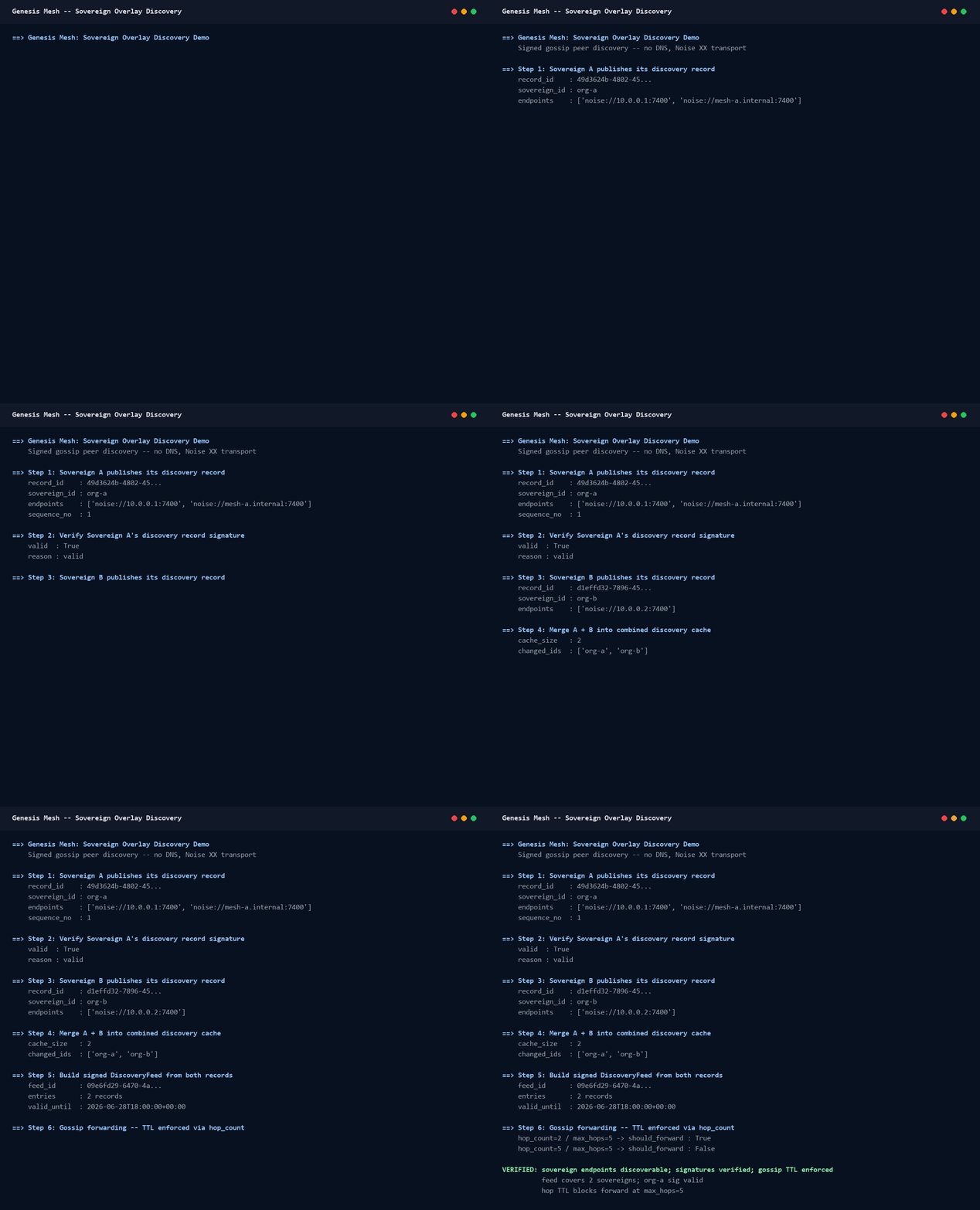
Step 1 — Announce your endpoint
genesis-mesh trust discover announce \
    --sovereign-id agent-a \
    --na-public-key "$(cat keys/agent-a.pub.b64)" \
    --endpoint http://agent-a.mesh:8443 \
    --endpoint overlay://abc123def456 \
    --capabilities-hash "$(cat manifest.hash)" \
    --sequence-no 1 \
    --valid-for-hours 24 \
    --signing-key keys/agent-a.key \
    --output record.json
[OK] OverlayDiscoveryRecord 4f2e9a12-...
     Sovereign : agent-a
     Endpoints : http://agent-a.mesh:8443, overlay://abc123def456
     Seq       : 1
     Valid for : 24h
     Output    : record.json
The record is signed with the sovereign’s Ed25519 key — anyone who already knows the public key can verify the binding without trusting DNS.
Step 2 — Verify a received record
genesis-mesh trust discover verify \
    --record incoming-record.json
[OK] valid — agent-b
Pass --known-sequence-no N to detect replays of superseded records:
genesis-mesh trust discover verify \
    --record incoming-record.json \
    --known-sequence-no 5
Step 3 — Merge records into your local cache
As peers gossip discovery records, merge them into your local cache. The
merge rule is: keep the highest sequence_no per sovereign, and discard
records with a lower sequence number than what is already cached.
genesis-mesh trust discover merge \
    --cache cache.json \
    --incoming record-from-peer.json \
    --output cache.json
[OK] Cache updated — 1 change(s): agent-b
     Total entries: 3
     Output       : cache.json
Step 4 — Build and publish a DiscoveryFeed
An operator can aggregate multiple records into a signed feed that peers can bootstrap from:
genesis-mesh trust discover feed \
    --record records/agent-a.json \
    --record records/agent-b.json \
    --record records/agent-c.json \
    --operator-sovereign operator-1 \
    --valid-for-hours 6 \
    --signing-key keys/operator.key \
    --output feed.json
[OK] DiscoveryFeed 9c4a1f22-...
     Operator : operator-1
     Records  : 3
     Valid for: 6h
     Output   : feed.json
Use in code
from genesis_mesh.trust.overlay_discovery import (
    create_discovery_record,
    verify_discovery_record,
    merge_discovery_records,
    gossip_should_forward,
    build_discovery_feed,
)
from genesis_mesh.models.overlay_discovery import DiscoveryGossipMessage
from datetime import datetime, timezone

# Create your own record
record = create_discovery_record(
    sovereign_id="agent-a",
    na_public_key_b64=pub_key_b64,
    endpoints=["http://agent-a.mesh:8443"],
    capabilities_hash=cap_hash,
    signing_key=signing_key,
    sequence_no=1,
    valid_for_hours=24,
)

# Verify an incoming record
ok, reason = verify_discovery_record(
    incoming_record,
    known_sequence_no=cache.get_sequence_no(incoming_record.sovereign_id),
)

# Decide whether to forward a gossip message
msg = DiscoveryGossipMessage(
    records=[record],
    origin_sovereign_id="agent-a",
    hop_count=2,
    max_hops=5,
    sent_at=datetime.now(timezone.utc),
)
if gossip_should_forward(msg):
    for peer in connected_peers:
        peer.send(msg.model_copy(update={"hop_count": msg.hop_count + 1}))
Gossip forwarding rules
Condition |
Action |
|---|---|
|
Forward to peers |
|
Drop (do not forward) |
Default max_hops = 5. Adjust in the gossip message for wider or narrower propagation.
Verification reasons
Reason |
Meaning |
|---|---|
|
Signature valid, not expired, not superseded |
|
|
|
Ed25519 verification failed |
|
|
|
A higher |
endpoint_unreachable is intentionally absent — network reachability is the
caller’s responsibility, not the discovery layer’s.
See also
CLI Reference —
genesis-mesh trust discoverreferenceExample: Verifiable Logic Attestation — attestation of what is executing at the discovered endpoint
Example: Communication Privacy Layer — metadata normalization for discovered-peer communication