Deployment Options
Genesis Mesh supports four deployment shapes. Pick the one that matches your operational target.
        flowchart TB
    secrets["Mounted secrets<br/>genesis.signed.json + na.key"]
    operator["OPERATOR_PUBLIC_KEYS_JSON"]
    container["Genesis Mesh container"]
    gunicorn["Gunicorn"]
    flask["Network Authority app"]
    sqlite["SQLite DB on durable volume"]
    ingress["Ingress / TLS termination"]

    ingress --> gunicorn
    gunicorn --> flask
    flask --> sqlite
    secrets -->|GENESIS_FILE, NA_PRIVATE_KEY_FILE| container
    operator --> container
    container --> gunicorn
Live Deployment
A public Network Authority runs on Azure (Sweden Central):
https://na.genesismesh.connectorzzz.com
Architecture
Azure VM (Terraform provisioned,
Standard_B2ts_v2, Sweden Central)Nginx with TLS termination (Let’s Encrypt)
Gunicorn (4 workers, sync worker class)
Genesis Mesh Network Authority (systemd-managed
genesis-mesh-na.service)SQLite persistence on a durable disk
Public endpoint: https://na.genesismesh.connectorzzz.com
Two enrolled nodes from separate IP addresses with active heartbeats.
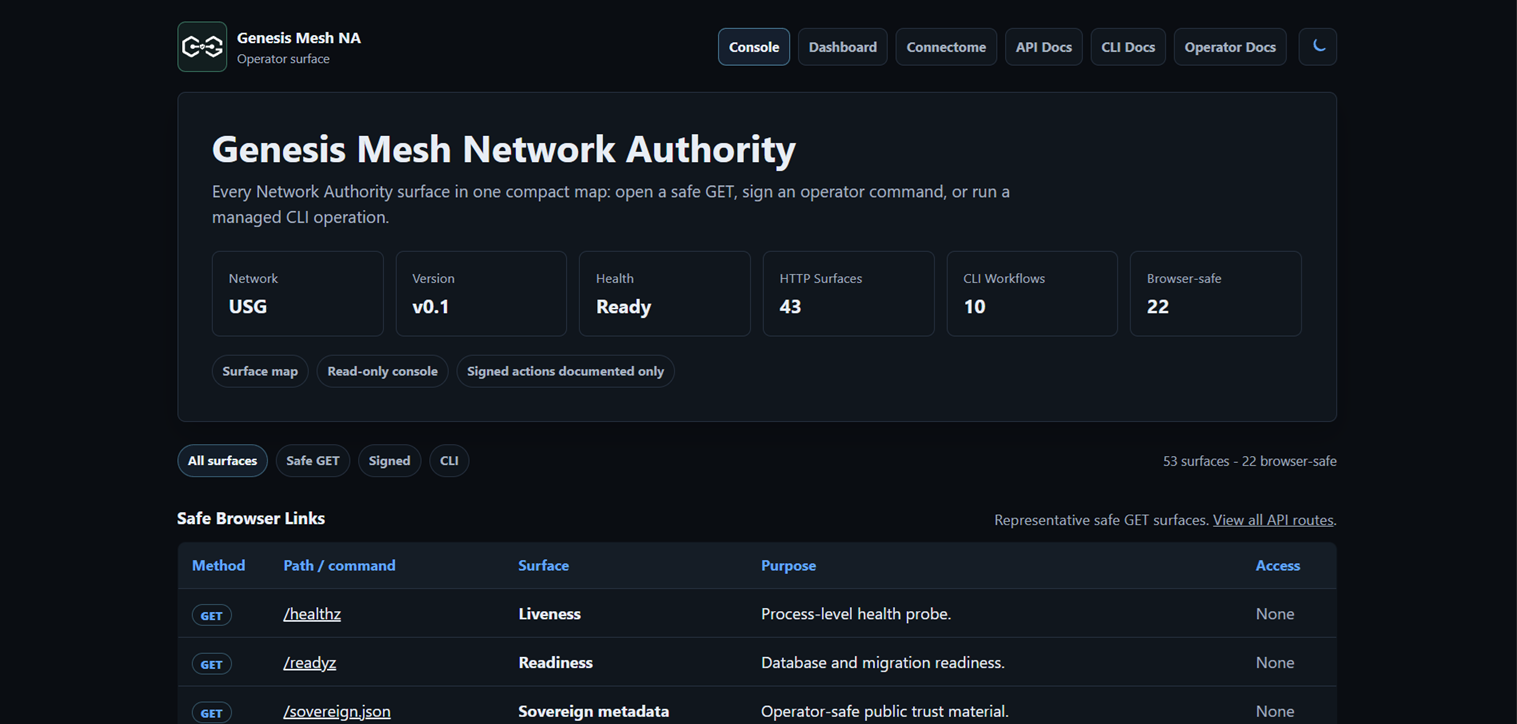

The roster shown above requires operator authentication. Without admin headers
/nodes returns the active count only — see
the public read surface.
1. Local Process
The fastest way to run a Network Authority. Suitable for development, demos, and CI smoke tests.
genesis-mesh init
genesis-mesh na start
genesis-mesh na start uses the Flask development server. For production
container or VM startup, use Gunicorn through start.sh.
2. Docker
The container entry point is start.sh. In Network Authority mode it runs
Gunicorn and requires mounted genesis and NA key files.
docker run --rm \
  -e SERVICE_ROLE=na \
  -e GENESIS_FILE=/run/secrets/genesis.signed.json \
  -e NA_PRIVATE_KEY_FILE=/run/secrets/na.key \
  -e OPERATOR_PUBLIC_KEYS_JSON='{"operator-local":"<base64-public-key>"}' \
  -e OPERATOR_KEY_TIERS_JSON='{"operator-local":"privileged"}' \
  -e DB_PATH=/data/genesis_mesh_na.db \
  -p 8443:8443 \
  genesis-mesh:local
For multi-container orchestration with a writable database volume, use the included Docker Compose example.
3. Kubernetes
A minimal set of manifests is provided under examples/kubernetes/:
kubectl apply -f examples/kubernetes/namespace.yaml
kubectl apply -f examples/kubernetes/na-secrets.yaml
kubectl apply -f examples/kubernetes/na-pvc.yaml
kubectl apply -f examples/kubernetes/na-deployment.yaml
kubectl apply -f examples/kubernetes/na-service.yaml
The Deployment runs a single non-root replica, mounts the genesis block and NA
key as a Secret, and persists the SQLite database to a PersistentVolumeClaim.
See: Kubernetes deployment guide and examples/kubernetes/README.md
4. Terraform on Azure
The infrastructure/azure/ directory contains a self-contained Terraform module
that provisions a complete Network Authority environment on Azure: resource
group, virtual network, subnet, public IP, NSG, network interface, and an Ubuntu
22.04 VM.
cd infrastructure/azure
terraform init \
  -backend-config="resource_group_name=terraform-state-rg" \
  -backend-config="storage_account_name=tfstategenesismesh" \
  -backend-config="container_name=tfstate" \
  -backend-config="key=genesis-mesh-na.tfstate"
terraform apply
The same module is driven from CI via
.github/workflows/deploy-azure.yml, which is how the live deployment at
https://na.genesismesh.connectorzzz.com was provisioned.
Release CD to the Azure VM
Terraform provisions the VM. Code updates for an existing VM are handled by
.github/workflows/deploy-release-azure-vm.yml.
The release deployment workflow runs when a GitHub release is published. It can
also be triggered manually from the Actions tab. The workflow connects to the
VM over SSH, backs up /var/lib/genesis-mesh/na.db, checks out the release tag,
updates the virtual environment, installs the current package, refreshes the
systemd unit files, restarts the NA and router services, then probes:
GET /healthzGET /readyzGET /connectome.json
Required GitHub secrets:
Secret |
Value |
|---|---|
|
Public hostname or IP address of the live VM |
|
Private SSH key allowed to log in to the VM |
Optional GitHub variables:
Variable |
Default |
Description |
|---|---|---|
|
|
SSH username |
|
|
SSH port |
These can be loaded from .env with:
bash infrastructure/scripts/setup-github-secrets.sh
Set NA_VM_SSH_PRIVATE_KEY_FILE in .env to read the private key from disk, or
set NA_VM_SSH_PRIVATE_KEY directly if your local shell can safely handle
multi-line values. The script never prints the private key.
The workflow deploys the release tag on release.published. For manual runs,
pass a tag such as v0.12.0 or a branch such as main.
This workflow is intentionally Azure-specific because the next proof levels may use a second VM on another cloud or a physical host. Add separate release-CD workflows for those targets instead of hiding multiple deployment environments behind one generic VM workflow.
Production Readiness Checks
Before promoting any of the deployment shapes above to production:
the container starts as a non-root user
required secret files are mounted
startup fails closed when required secret files are missing
/healthzand/readyzwork behind the selected ingressSQLite data is persisted on durable storage
backups are tested
operator public keys are reviewed and rotated through policy
logs do not expose private key material
Do not run two Network Authority processes against the same SQLite database file. Genesis Mesh treats SQLite as a single-writer deployment store.