Justification Proofs
A BoundaryDecision carries a signed verdict: authorized or denied, gate names,
and a denial reason. An auditor receiving it knows what the engine concluded
but not how it reached that conclusion — which inputs entered each gate, what
intermediate values each gate computed, and where evaluation short-circuited.
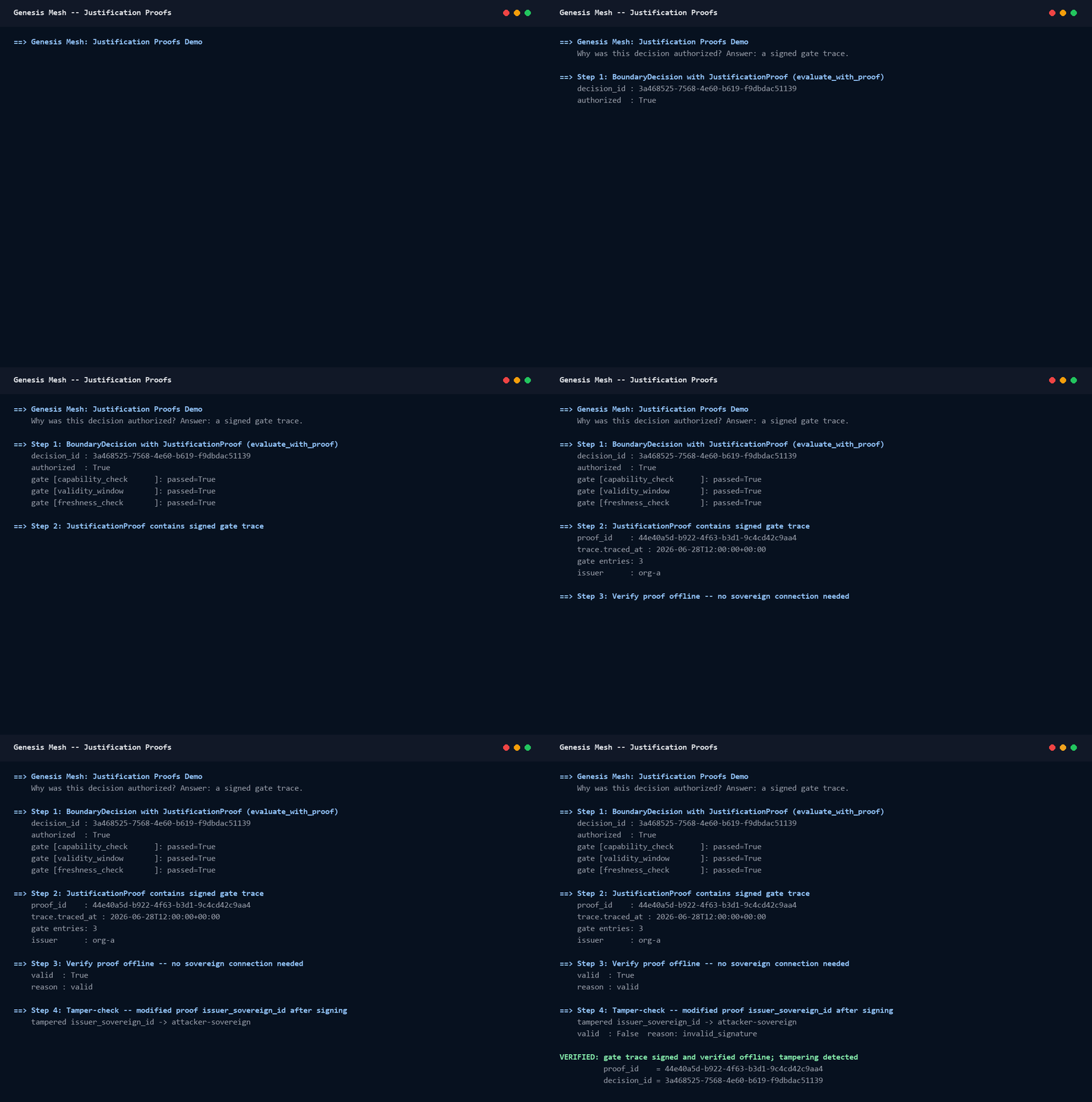
A Justification Proof closes this gap. It is a signed artefact that captures
the ordered gate trace from a single BoundaryEngine.evaluate_with_proof() call
and binds it to the corresponding BoundaryDecision. Any holder of the operator’s
public key can verify the reasoning offline without re-running the engine.
BoundaryDecision ←── signed over ──→ JustificationProof
                                             │
                                       GateTrace
                                             │
                               ┌──────────────────────┐
                               │ GateTraceEntry (×N)  │
                               │  gate_name           │
                               │  gate_type           │
                               │  evaluated_at        │
                               │  inputs  ←── per-gate│
                               │  result              │
                               │  reason              │
                               └──────────────────────┘
Research basis
arXiv:2605.15228 — Verifiable Agentic Infrastructure (2026): introduces the justification proof as “an encoded artifact that establishes the admissibility basis of an action by capturing the reasoning behind authorization decisions.” Argues that “autonomous AI agents can generate syntactically valid but semantically unsafe actions, making traditional identity-centric authorization insufficient.”
arXiv:2605.05440 — Authorization Propagation in Multi-Agent AI Systems (2026):
Structural requirement 3 is “dependency-graph policy enforcement” — every policy
gate evaluation must record which dependency inputs it consumed and what it
produced. This is exactly the GateTrace structure.
CLI quickstart
Evaluate with proof emission
# Evaluate a context and emit the decision + trace (then sign the trace)
genesis-mesh trust context evaluate \
    --agreement agreement.json \
    --context ctx.json \
    --signing-key keys/operator.key \
    --output decision.json

# The trace.json is produced alongside the decision when using the Python API
# (see Python section below). CLI sign re-signs an existing trace.
genesis-mesh trust justify sign \
    --decision decision.json \
    --trace trace.json \
    --signing-key keys/operator.key \
    --output proof.json
Output:
Proof    : 3a7f1c2d-...
Decision : e9b0a5f1-...
Gates    : 3
Auth     : True
Output   : proof.json
Verify a proof
# Signature check only
genesis-mesh trust justify verify \
    --proof proof.json \
    --verify-key <base64-operator-pub>

# With decision cross-check (gate count, decision_id binding)
genesis-mesh trust justify verify \
    --proof proof.json \
    --verify-key <base64-operator-pub> \
    --decision decision.json
Output (success):
[OK] valid
Proof    : 3a7f1c2d-...
Decision : e9b0a5f1-...
Gates    : 3
Auth     : authorized
Output (failure):
[FAIL] invalid_signature
Exit code 1 on failure.
Python API
Emit a proof alongside a decision
from genesis_mesh.trust.context import BoundaryEngine

engine = BoundaryEngine("bank-a", decision_valid_seconds=300)
decision, proof = engine.evaluate_with_proof(
    ctx, agreement, signing_key, issued_by="op-key"
)

# decision: BoundaryDecision (identical to engine.evaluate())
# proof:    JustificationProof (signed, contains the GateTrace)
print(decision.authorized)            # True / False
print(proof.trace.short_circuited_at) # None if all gates passed
print(proof.trace.entries[0].inputs)  # per-gate inputs
Save for offline audit
from pathlib import Path
Path("decision.json").write_text(decision.model_dump_json(indent=2))
Path("trace.json").write_text(proof.trace.model_dump_json(indent=2))
Path("proof.json").write_text(proof.model_dump_json(indent=2))
Verify offline
from genesis_mesh.models.justification import JustificationProof
from genesis_mesh.trust.justification import verify_justification_proof

proof = JustificationProof.model_validate_json(Path("proof.json").read_text())
result = verify_justification_proof(proof, [operator_pub_b64], decision=decision)

print(result.valid)   # True / False
print(result.reason)  # "valid" | "missing_signature" | "invalid_signature" | ...
What the trace captures
For each built-in gate the trace records the exact inputs evaluated:
Gate |
|
Inputs captured |
|---|---|---|
Capability |
|
|
Validity window |
|
|
Freshness |
|
|
Freshness proof |
|
|
Custom gates |
|
|
Short-circuit visibility
When the engine short-circuits on the first failed gate, the trace records only the gates that actually ran:
Capability check → FAILED (short-circuit here)
Validity window  → (never evaluated)
Freshness check  → (never evaluated)
The GateTrace.short_circuited_at field names the first failed gate.
JustificationProof.trace.entries contains exactly one entry in this case.
Verification reason codes
Reason |
Meaning |
|---|---|
|
Signature valid; optional decision cross-check passed |
|
Proof has no signature |
|
Signature does not verify against any supplied public key |
|
|
|
|
|
|
What this does not do
Does not replace
BoundaryDecision: the decision remains the authoritative authorization outcome. The proof is an audit supplement.Does not prevent replay: a proof is a static artefact; replay protection is the responsibility of the execution layer (see Execution Evidence).
Does not capture custom gate inputs: custom gates added via
engine.add_gate()appear in the trace withgate_type = "CustomGate"and emptyinputs. Custom gate implementations can populatemetadataif they need to record their own state.