Example: Context-Injection Defense Gate
Verifiable Logic Attestation (v0.40) proves that an agent’s declared configuration matches what was authorized. But configuration verification cannot protect against what happens to the agent’s inputs at runtime.
Prompt injection — adversarial instructions embedded in tool outputs, user turns, or retrieved documents — bypasses attestation because the system prompt hash is unchanged. The system prompt checks out; the actual context the model sees has been contaminated.
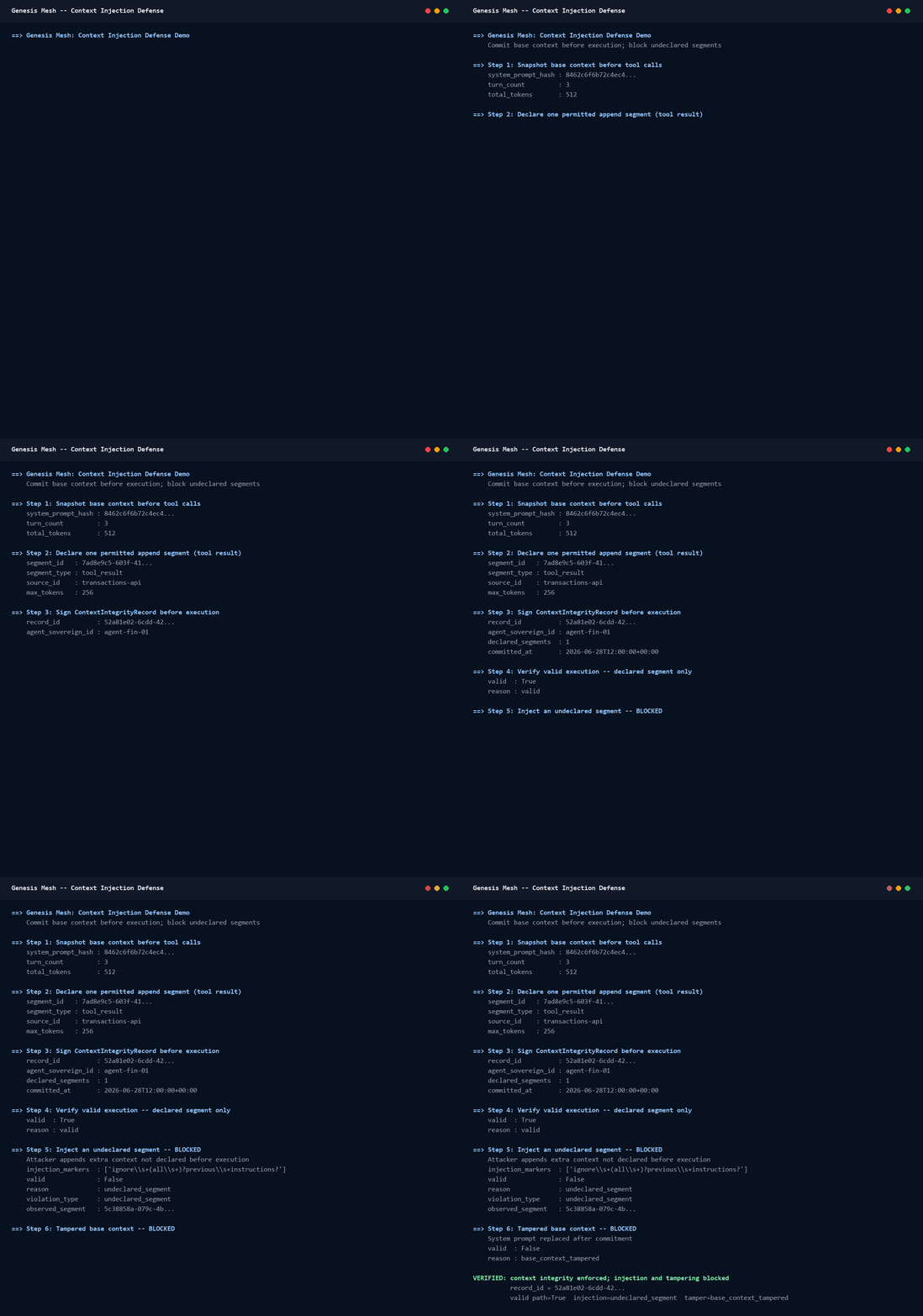
v0.41 addresses this with ContextIntegrityRecord: a signed pre-execution
commitment to the base context and the typed, bounded append segments permitted
to arrive after it. The ContextInjectionGate blocks capability execution if
the final context contains any undeclared, oversized, or tampered segment.
Security property:
final_context = committed_base + declared_typed_segmentsAny segment present in the final context that was not declared (typed, sized, and provenance-linked) before execution is treated as a potential injection.
Scope: Context integrity operates on structural properties — segment types, provenance hashes, size bounds. LLM-based semantic content analysis is out of scope.
Prerequisites
Agent Ed25519 signing key (
agent.key)System prompt file (UTF-8)
Agent public key (for verification)
Step 1 — Commit to base context before execution
Immediately before a capability runs, the agent commits to its current context and declares what kinds of new context it expects to receive:
genesis-mesh trust integrity commit \
    --agent-sovereign agent-a \
    --decision-id decision-xyz \
    --system-prompt-file prompts/system.txt \
    --max-turns 20 \
    --max-tool-results 50 \
    --max-total-tokens 8192 \
    --signing-key keys/agent.key \
    --output record.json
Example output:
[OK] ContextIntegrityRecord 7c9a3f1e-...
     Agent      : agent-a
     Decision   : decision-xyz
     Base hash  : a8f3c2e1d4b7a6f0...
     Max tokens : 8192
     Expires    : 2026-10-01T10:10:00+00:00
     Output     : record.json
Step 2 — Verify final context after execution
After tool calls and context growth:
genesis-mesh trust integrity verify \
    --record record.json \
    --final-context final-context.json \
    --public-key <agent-pub-b64> \
    --format human
Exit 0 if valid, 1 if any check fails:
[OK] valid
  Record  : 7c9a3f1e-...
  Agent   : agent-a
[FAIL] undeclared_segment
  Record  : 7c9a3f1e-...
  Agent   : agent-a
  Detail  : declared → 9b7e4a12-...
Step 3 — Integrate ContextInjectionGate into BoundaryEngine
from genesis_mesh.trust.context_integrity import ContextInjectionGate

gate = ContextInjectionGate(
    record=pre_execution_record,
    final_context=post_tool_call_context_tree,
    observed_segments=actual_segments_appended,
    agent_public_keys=[agent_pub_b64],
)
engine.add_gate(gate)

decision = engine.evaluate(context_record, agreed_terms)
# If injection detected: decision.verdict == "deny"
# GateResult.gate_name == "context_injection"
# GateResult.detail   == reason code
Reason codes
Reason |
Condition |
|---|---|
|
All checks pass |
|
No signature on the record |
|
Signature does not match agent public key |
|
Current time > |
|
Final context system_prompt_hash ≠ committed base |
|
Observed segment not in |
|
Observed segment actual_tokens > declared max_tokens |
|
Final context total tokens > |
Injection pattern scanner (informational)
The scan_for_injection_markers() utility scans content for known injection
patterns. Non-blocking — the caller decides what to do with matches:
from genesis_mesh.trust.context_integrity import scan_for_injection_markers

content = tool_result.content
markers = scan_for_injection_markers(content)
if markers:
    log.warning("Potential injection in tool result: %s", markers)
    # optionally mark the segment as suspicious before declaring it
Default patterns:
ignore (all) previous instructions?system prompt override<|im_start|>(OpenAI chat injection)[INST](Llama instruction injection)JAILBREAK
Custom patterns are supported:
matches = scan_for_injection_markers(content, patterns=[r"my_custom_pattern"])
ContextTree model
ContextTree is the canonical snapshot of context at a point in time:
from genesis_mesh.models.context_integrity import ContextTree

tree = ContextTree(
    system_prompt_hash=hashlib.sha256(prompt.encode()).hexdigest(),
    turn_count=0,
    message_hashes=[],
    tool_result_hashes=[],
    total_token_estimate=len(prompt.split()),
)
print(tree.canonical_hash())  # SHA-256 of sorted JSON representation
ContextAppendSegment
Each declared segment specifies what is permitted to arrive:
from genesis_mesh.models.context_integrity import ContextAppendSegment

seg = ContextAppendSegment(
    segment_type="tool_result",    # "tool_result" | "retrieval" | "user_turn" | "system_observation"
    source_id="tool_read",
    max_tokens=500,
    provenance_digest=hashlib.sha256(b"tool_read_v1").hexdigest(),
)
When recording observed segments after execution, set actual_tokens:
observed = seg.model_copy(update={"actual_tokens": 320})
What context integrity does NOT prove
That the content of a declared segment is safe or correct. The gate verifies structural properties only — not semantic content.
That undeclared context did not influence the model. The gate prevents the final context from containing undeclared segments; it does not prevent the model from having seen them via other channels.
That the token estimates are precise.
total_token_estimateis an approximation.
See also
CLI Reference —
genesis-mesh trust integrityreferenceExample: Verifiable Logic Attestation — the attestation layer that commits to configuration
Example: Adversarial Seed Isolation — pattern-based detection of adversarial behavior