Example: Recognition Treaties
This example shows direct recognition between two independently administered sovereign trust domains.
The goal is to prove the v0.10.0 primitive:
Sovereign B issues a membership attestation.
Sovereign A signs a recognition treaty for Sovereign B.
Sovereign A accepts B's attestation through that treaty.
Sovereign A revokes the treaty.
The same attestation is rejected.
Sovereign A exports the recognition graph.
Recognition treaties are intentionally narrow. They are not reputation scores, marketplace listings, or transitive trust. They are signed, scoped, revocable direct-recognition artifacts that say one sovereign accepts attestations from another sovereign under explicit local rules.
        sequenceDiagram
    participant B as Sovereign B
    participant A as Sovereign A
    participant G as Recognition Graph

    B->>B: Issue MembershipAttestation(alice, role:service:maintainer)
    A->>A: Sign RecognitionTreaty(subject=Sovereign B, scope=maintainer)
    B-->>A: Present attestation
    A->>A: Verify treaty signature, scope, status, subject key
    A->>A: Verify attestation signature against treaty subject key
    A-->>B: accepted

    A->>A: Revoke RecognitionTreaty
    B-->>A: Present same attestation again
    A-->>B: rejected: treaty_locally_revoked
    A->>G: Export sovereign nodes, recognition edges, revoked trust material
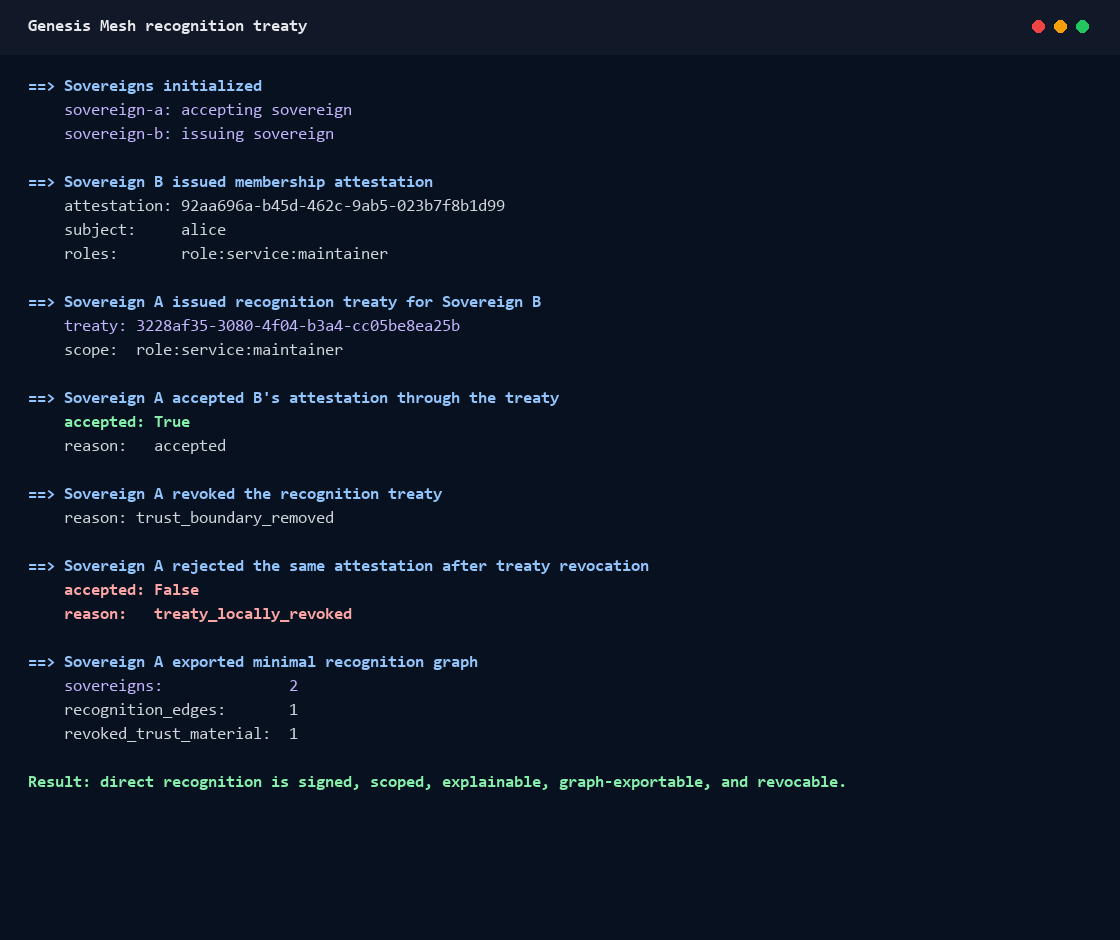
Static walkthrough:
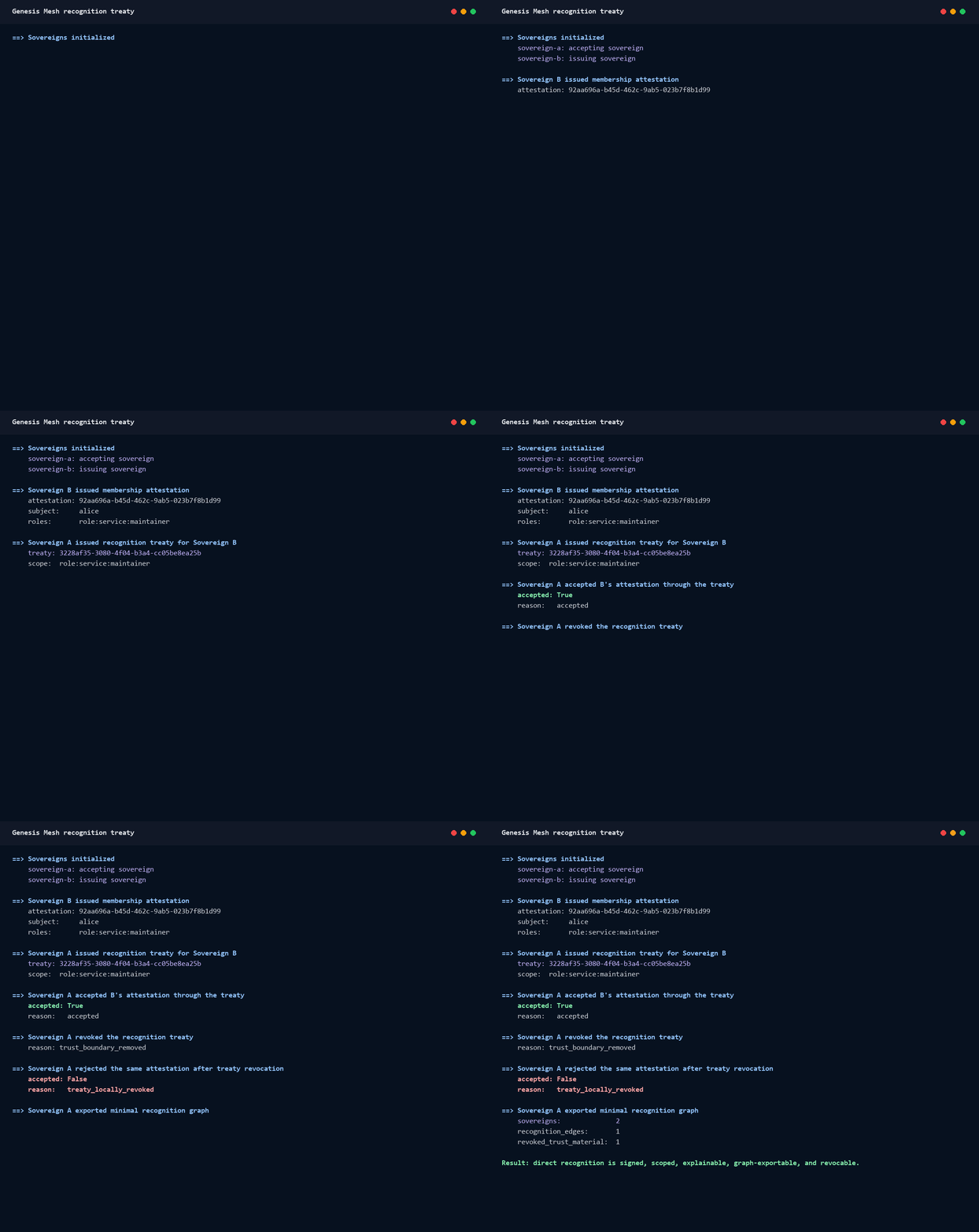
Animated execution:
What This Proves
Two sovereigns can run with separate genesis blocks, NA keys, operator keys, and SQLite databases.
A treaty can scope which roles are accepted from the recognized sovereign.
A membership attestation can be accepted through a treaty without adding a local recognition policy by hand.
Revoking the treaty changes trust state immediately in the accepting sovereign.
Minimal recognition graph export exists before a full Connectome UI.
Next Step: Cross-Sovereign Revocation
Treaty revocation removes a whole recognition relationship. v0.11 adds a narrower path: the issuer sovereign can revoke a specific membership attestation and publish a signed revocation feed. The accepting sovereign imports that feed and rejects the revoked attestation while keeping the treaty active for future trust material.
See the v0.11 walkthrough:
Run Locally
The demo is in-process and does not require Docker, DNS, or external services. It creates both sovereigns in a temporary directory and cleans them up at exit.
python docs\examples\assets\scripts\recognition-treaty-demo.py
Expected proof:
==> Sovereign B issued membership attestation
    subject:     alice
    roles:       role:service:maintainer

==> Sovereign A issued recognition treaty for Sovereign B
    scope:  role:service:maintainer

==> Sovereign A accepted B's attestation through the treaty
    accepted: True
    reason:   accepted

==> Sovereign A revoked the recognition treaty
    reason: trust_boundary_removed

==> Sovereign A rejected the same attestation after treaty revocation
    accepted: False
    reason:   treaty_locally_revoked

==> Sovereign A exported minimal recognition graph
    sovereigns:              2
    recognition_edges:       1
    revoked_trust_material:  1
Recognition Graph Export
The /recognition-graph endpoint returns the data needed by future Connectome
viewers:
sovereign nodes
direct recognition edges
active treaty count
revoked treaty and attestation material
The export is deliberately data-first. Any operator can render their own trust graph without depending on a central Genesis Mesh viewer.
Boundaries
v0.10.0 treats recognition treaties as the base primitive for direct sovereign-to-sovereign recognition. Derived or transitive recognition is a later overlay computed on top of the treaty graph with explicit depth limits. Unbounded transitive trust is intentionally avoided because it can become a supply-chain attack surface.