Peer Risk Signals
This is not a reputation system. GenesisMesh does not rank sovereigns globally. There is no shared reputation ledger, no federation-wide score, and no cross-sovereign ranking. Each sovereign computes and stores its own local signals for its own decisions only. Two sovereigns observing the same counterparty will have independent, unshared signals.
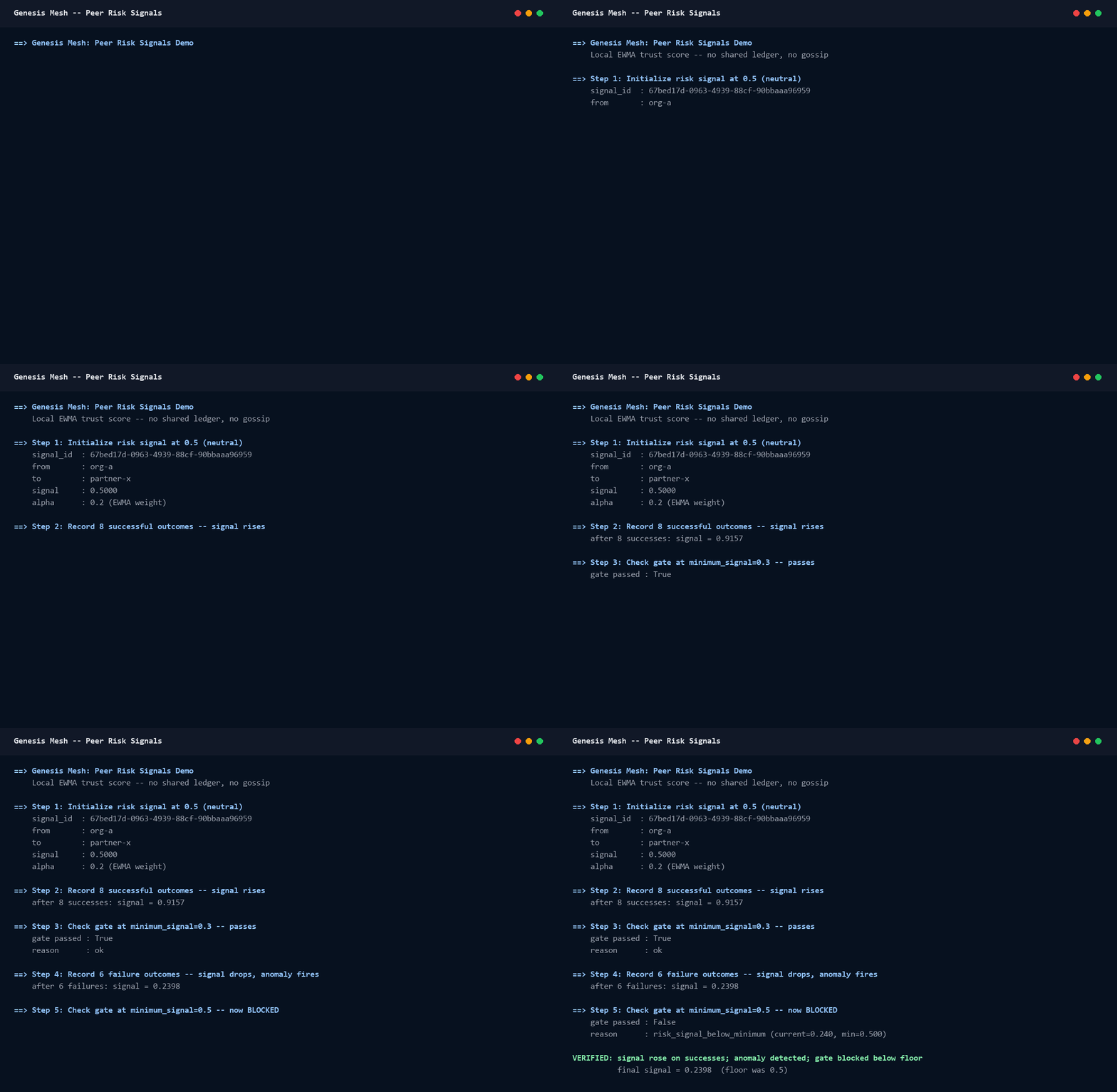
What are peer risk signals?
A PeerRiskSignal is a locally-computed, time-decaying summary of how reliably
a counterparty has behaved over the execution history your sovereign has observed
directly. It is updated from ExecutionEvidence outcomes and sits entirely within
your local trust store.
Signal value is always in [0.0, 1.0]:
Value |
Interpretation |
|---|---|
~1.0 |
Consistently successful recent history |
~0.5 |
Mixed or newly-established history (default start) |
~0.0 |
Recent failures dominate, or signal has decayed |
Algorithm
Decay (applied before every update and on schedule):
signal = signal × exp(-λ × elapsed_days)
Default λ = 0.05 — signal halves in ≈ 14 days with no updates.
EWMA update (on new ExecutionEvidence):
outcome_value = {"success": 1.0, "partial": 0.5, "failure": 0.0}[evidence.outcome]
signal = α × outcome_value + (1 - α) × decayed_signal
Default α = 0.2.
Anomaly detection (when ≥ 10 RiskSignalUpdate records exist):
Δ = posterior - prior_after_decay
if |Δ - mean(last_10_deltas)| > 3σ:
    emit RiskAnomaly
CLI quickstart
# 1. Create a new signal for a counterparty (initial signal = 0.5)
genesis-mesh trust risk create \
    --from-sovereign sovereign-a \
    --to-sovereign counterparty-b \
    --signing-key keys/sov-a.key \
    --output signals/b.json

# 2. Update after an execution completes
genesis-mesh trust risk update \
    --signal signals/b.json \
    --evidence evidence.json \
    --signing-key keys/sov-a.key \
    --output signals/b-updated.json \
    --output-anomaly anomaly.json

# 3. Scheduled decay (e.g. daily cron job)
genesis-mesh trust risk decay \
    --signal signals/b-updated.json \
    --signing-key keys/sov-a.key \
    --output signals/b-decayed.json

# 4. Inspect current state
genesis-mesh trust risk show \
    --signal signals/b-decayed.json \
    --format json
Python API
from genesis_mesh.trust.risk_signal import (
    create_risk_signal,
    update_risk_signal,
    decay_risk_signal,
    RiskSignalGate,
)
from genesis_mesh.models.execution import ExecutionEvidence

# Create
signal = create_risk_signal("sovereign-a", "counterparty-b", signing_key)

# Update after execution
evidence = ExecutionEvidence(
    sequence_no=1,
    decision_id=decision_id,
    context_id=context_id,
    agreement_id=agreement_id,
    executor_sovereign_id="sovereign-a",
    executed_capability="transactions.send",
    outcome="success",
)
updated_signal, update_record, anomaly = update_risk_signal(
    signal, evidence, signing_key, history=update_history
)
if anomaly:
    print(f"Anomaly: {anomaly.sigma_multiples:.1f}σ drop detected")

# Scheduled decay
decayed_signal = decay_risk_signal(signal, signing_key)

# Use as a BoundaryEngine gate (opt-in)
gate = RiskSignalGate(
    signal=updated_signal,
    minimum_signal=0.4,
    issuer_public_keys=[sovereign_a_pub_b64],
)
engine.add_gate(gate)
decision = engine.evaluate(ctx, agreement, operator_sk, issued_by="sovereign-a")
Risk signal gate
The RiskSignalGate is an opt-in extension to BoundaryEngine. Normal
authorization is completely unaffected when no gate is added.
When added, the gate:
Verifies the signal’s Ed25519 signature.
Applies time decay to the current moment.
Checks that the decayed value ≥
minimum_signal.
Gate result detail strings:
Detail |
Meaning |
|---|---|
|
Signature absent or cryptographically invalid |
|
Signal is too low to proceed |
Anomaly detection
A RiskAnomaly is raised when a new delta is more than sigma_threshold standard
deviations from the mean of the last 10 deltas. Lowering anomaly_sigma_threshold
from the default 3.0 to 1.0 makes detection more sensitive.
_, update_record, anomaly = update_risk_signal(
    signal, evidence, signing_key,
    history=update_history,
    anomaly_sigma_threshold=1.5,  # custom threshold
)
Anomaly detection requires ≥ 10 prior RiskSignalUpdate records. Fewer than
10 records never trigger an anomaly.
Research basis
Paper |
Relevant finding |
|---|---|
arXiv:2603.15809 — Don’t Trust Stubborn Neighbors |
Defense via local, per-peer trust-adaptive weighting |
arXiv:2605.05440 — Authorization Propagation in Multi-Agent AI Systems |
Req 5: decay over time; Req 7: aggregate across interactions |
arXiv:2604.02767 — SentinelAgent |
Anomaly detection in multi-agent authorization pipelines |