Invocation-Bound Capability Tokens (IBCTs)
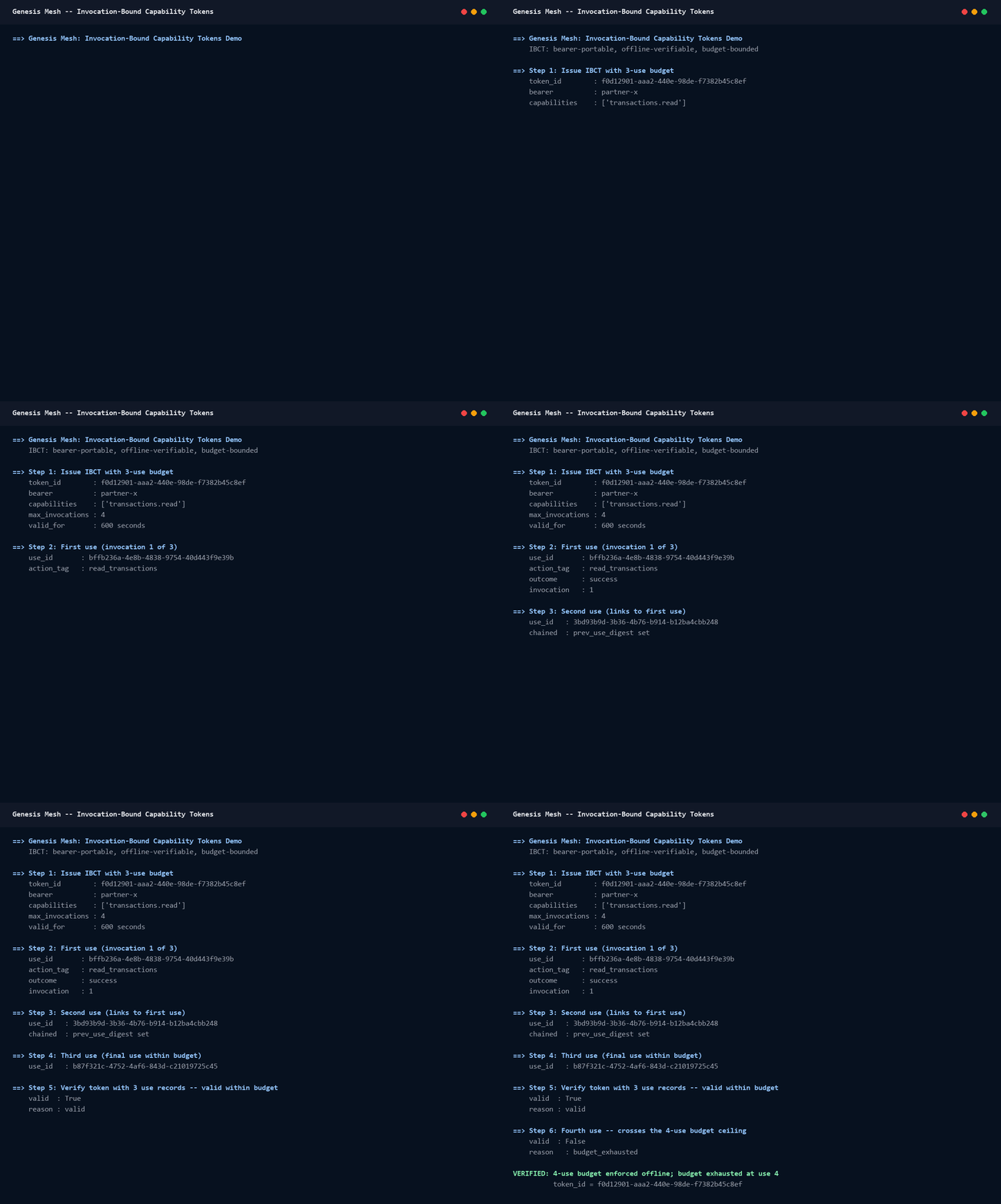
What problem do IBCTs solve?
A BoundaryDecision answers “was this agent authorised?” at the time the
decision was evaluated. But it does not produce a portable, self-contained
artefact the agent can carry to a resource — a resource that may be at the
edge, offline from the GM stack, and unable to call back for verification.
An Invocation-Bound Capability Token (IBCT) fills this gap. It is a compact, Ed25519-signed JSON record that fuses:
Sovereign identity — bearer and issuer are named and bound
Attenuated capabilities — always a subset of the source agreement or delegation
Invocation budget — optional cap on how many times the token may be used
Policy constraints — time windows, peer-sovereign restrictions
Use chain — each invocation produces a signed
InvocationUseRecordlinked byprev_use_digest, forming a tamper-evident ledger
Any verifier holding the issuer’s Ed25519 public key can validate the token offline in sub-millisecond time — no GM stack call required.
Based on: arXiv:2603.24775 — AIP: Agent Identity Protocol for Verifiable Delegation Across MCP and A2A (2026)
Quick-start
1. Issue a token
genesis-mesh trust token issue \
    --agreement agreement.json \
    --bearer agent-b \
    --caps "transactions.read" \
    --signing-key operator.key --key-id op-2026 \
    --valid-for 300 \
    --output token.json
Output:
Token     : 3b7e9f12-...
Bearer    : agent-b
Issuer    : org-a
Caps      : transactions.read
Budget    : unlimited
Expires at: 2026-07-01T12:05:00+00:00
Output    : token.json
2. Verify a token at the resource
genesis-mesh trust token verify \
    --token token.json \
    --verify-key operator.pub \
    --capability "transactions.read" \
    --bearer agent-b
Output:
[OK] valid
Token     : 3b7e9f12-...
Bearer    : agent-b
Capability: transactions.read
Budget    : unlimited max, 0 used
3. Record a use
genesis-mesh trust token record-use \
    --token token.json \
    --action "transactions.read" \
    --outcome success \
    --signing-key agent.key --key-id agent-2026 \
    --output use-1.json
4. Chain a second use
genesis-mesh trust token record-use \
    --token token.json \
    --action "transactions.read" \
    --outcome success \
    --prior use-1.json \
    --signing-key agent.key \
    --output use-2.json
Budget-limited tokens
Set --max-invocations to cap the number of uses:
genesis-mesh trust token issue \
    --agreement agreement.json \
    --bearer agent-b \
    --caps "transactions.read" \
    --max-invocations 3 \
    --signing-key operator.key \
    --output limited-token.json
Verification with use records:
genesis-mesh trust token verify \
    --token limited-token.json \
    --verify-key operator.pub \
    --capability "transactions.read" \
    --bearer agent-b \
    --use-record use-1.json \
    --use-record use-2.json \
    --use-record use-3.json
When all three records are provided and max_invocations=3, the verifier
returns budget_exhausted.
Policy constraints
Two constraint types are supported:
Constraint |
Example |
Effect |
|---|---|---|
|
|
Token is not valid before this time |
|
|
Additional check that bearer matches |
Unrecognised constraints are rejected
Verification fails closed. A constraint outside the table above cannot be
evaluated, so the verifier does not treat it as satisfied — it returns
policy_violated and logs a warning naming the predicate:
WARNING genesis_mesh.trust.invocation_token: Rejecting InvocationToken <id>:
unrecognised policy constraint 'geo:eu-only' (this build understands
not_before:, peer_sovereign:)
Issuing a token with such a constraint is still allowed (it may be intended for a newer verifier), but it logs a warning at issuance too.
Version-compatibility note. The set of understood predicates is a property of the verifier’s build, not of the token. A token minted by a newer issuer that carries a predicate an older verifier does not know will be rejected by that older verifier — the safe direction, but a real failure mode. When a new predicate is added to the vocabulary, roll verifiers out before issuers begin minting tokens that use it, and record the addition in the changelog. Within a single version there is no compatibility question: both supported predicates behave exactly as the table describes.
genesis-mesh trust token issue \
    --agreement agreement.json \
    --bearer agent-b \
    --caps "transactions.read" \
    --constraint "not_before:2026-07-01T00:00:00Z" \
    --constraint "peer_sovereign:agent-b" \
    --signing-key operator.key \
    --output constrained-token.json
Delegation-derived tokens
When a token is derived from a DelegatedAgreementRecord rather than the root
agreement, pass --delegation:
genesis-mesh trust token issue \
    --agreement agreement.json \
    --delegation delegation.json \
    --bearer agent-c \
    --caps "transactions.read" \
    --signing-key delegator.key \
    --output delegated-token.json
The capabilities are validated against delegation.delegated_terms.capabilities
(not the root agreement) — the attenuation guarantee is preserved at every hop.
Verification reason codes
Reason |
Meaning |
|---|---|
|
All checks passed |
|
No signature on the token |
|
Signature does not verify against any supplied key |
|
|
|
|
|
Requested capability not in |
|
|
|
A |
Python API
from genesis_mesh.models.agreement import AgreementRecord
from genesis_mesh.trust.invocation_token import (
    issue_invocation_token,
    verify_invocation_token,
    record_invocation_use,
)

# Issue
token = issue_invocation_token(
    agreement,
    bearer_sovereign_id="agent-b",
    capabilities=["transactions.read"],
    signing_key=sk,
    issued_by="op-2026",
    max_invocations=5,
)

# Verify
result = verify_invocation_token(
    token,
    [public_key_b64],
    requested_capability="transactions.read",
    bearer_sovereign_id="agent-b",
)
assert result.valid  # result.reason == "valid"

# Record a use
use = record_invocation_use(
    token, "transactions.read", "success", bearer_sk, used_by="bearer-key"
)

# Chain a second use
use2 = record_invocation_use(
    token, "transactions.read", "success", bearer_sk,
    used_by="bearer-key", prior_use=use,
)
assert use2.prev_use_digest == use.digest()
Use-chain tamper-evidence
Each InvocationUseRecord carries prev_use_digest = SHA-256(prior.canonical_json).
Deleting, inserting, or reordering records breaks the chain — the same guarantee
as ExecutionEvidence (v0.29).
use-1  prev_use_digest=None
use-2  prev_use_digest=SHA-256(use-1)
use-3  prev_use_digest=SHA-256(use-2)
Tampering with use-2 changes use-2.digest(), which invalidates use-3.prev_use_digest.