Worked Example: Execution Evidence Hash Chain
This example shows how two sovereigns record post-authorization execution events as a tamper-evident hash chain, and how a verifier confirms chain integrity.
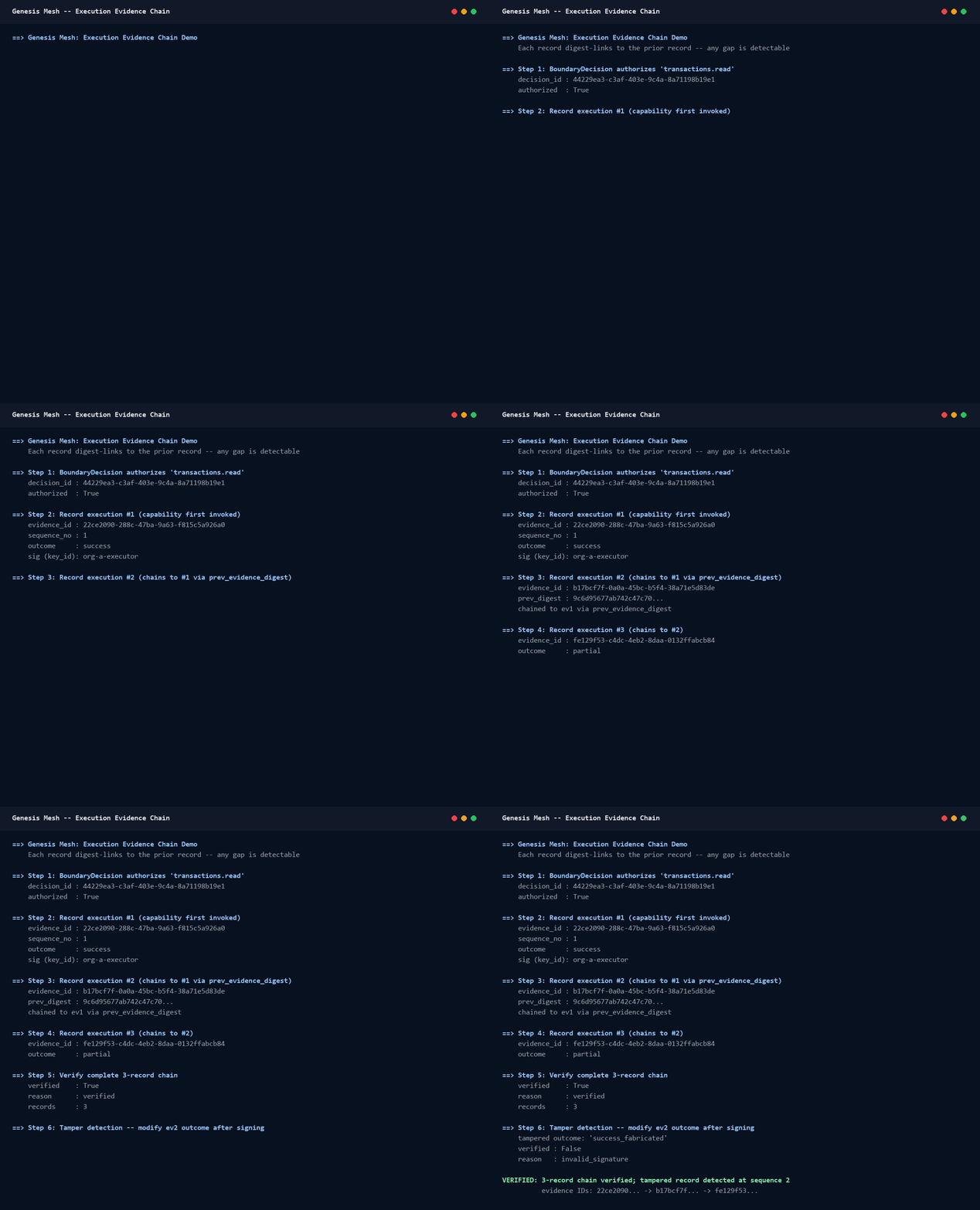
Scenario
org-a and bank-a have an active AgreementRecord for
transactions.read. After bank-a’s BoundaryEngine issues a
BoundaryDecision authorizing the request, bank-a executes the
capability three times and records each execution as a signed
ExecutionEvidence record, linked via prev_evidence_digest.
Step 1 — Obtain a BoundaryDecision
Start from an evaluated context (see Relationship Context):
# Assuming decision.json is the signed BoundaryDecision from the previous step
cat decision.json | python -c "import sys,json; d=json.load(sys.stdin); print(d['decision_id'])"
# → 3b7e9f12-...
Step 2 — Record the first execution
genesis-mesh trust execution record \
    --decision decision.json \
    --capability transactions.read \
    --executor bank-a \
    --outcome success \
    --params '{"account_id":"acct-001","limit":100}' \
    --sequence 1 \
    --signing-key keys/bank-a.key --key-id bank-a-2026 \
    --output evidence-1.json
Evidence  : a1b2c3d4-...
Sequence  : 1
Decision  : 3b7e9f12-...
Capability: transactions.read
Outcome   : success
Prev digest: (none — first in chain)
Output    : evidence-1.json
Step 3 — Record subsequent executions (chained)
Each record links to the prior via --prior:
# Second execution
genesis-mesh trust execution record \
    --decision decision.json \
    --capability transactions.read \
    --executor bank-a \
    --outcome success \
    --params '{"account_id":"acct-002","limit":50}' \
    --sequence 2 \
    --prior evidence-1.json \
    --signing-key keys/bank-a.key --key-id bank-a-2026 \
    --output evidence-2.json

# Third execution
genesis-mesh trust execution record \
    --decision decision.json \
    --capability transactions.read \
    --executor bank-a \
    --outcome partial \
    --outcome-detail "Rate limit applied; partial result returned" \
    --params '{"account_id":"acct-003","limit":200}' \
    --sequence 3 \
    --prior evidence-2.json \
    --signing-key keys/bank-a.key --key-id bank-a-2026 \
    --output evidence-3.json
Each record’s prev_evidence_digest is the SHA-256 of the prior record’s
canonical JSON — binding the chain at signing time.
Step 4 — Verify the chain
genesis-mesh trust execution verify \
    --decision-id 3b7e9f12-... \
    --evidence evidence-1.json \
    --evidence evidence-2.json \
    --evidence evidence-3.json \
    --key bank-a:<bank-a-public-key-b64> \
    --expected-capability transactions.read
[OK] verified
Chain     : 3 record(s)
Exit code 0 means: sequence 1-2-3 is contiguous, all prev_evidence_digest
values match, and all signatures are valid.
Step 5 — Detect tampering
Swap records 2 and 3 to simulate an audit log manipulation:
genesis-mesh trust execution verify \
    --decision-id 3b7e9f12-... \
    --evidence evidence-1.json \
    --evidence evidence-3.json \
    --evidence evidence-2.json \
    --key bank-a:<bank-a-public-key-b64>
[FAIL] digest_mismatch
Chain     : 3 record(s)
Failed at : sequence 3
Exit code 1. The verifier detected that record 3’s prev_evidence_digest
does not match the SHA-256 of record 1 (it expected record 2 as the prior).
JSON output
For machine-readable output:
genesis-mesh trust execution verify \
    --decision-id 3b7e9f12-... \
    --evidence evidence-1.json \
    --key bank-a:<bank-a-public-key-b64> \
    --format json
{
  "verified": true,
  "reason": "verified",
  "chain_length": 1,
  "failed_at_sequence": null
}
What the chain guarantees
Property |
Mechanism |
|---|---|
No record was silently dropped |
|
No record was reordered or inserted |
|
No record was tampered |
Ed25519 signature over canonical JSON (including |
No record was signed by an unknown party |
Verifier supplies known public keys per sovereign |
The BoundaryDecision acts as the authorization anchor; every ExecutionEvidence
record is independently signed by the executor but cryptographically bound to
all prior records in the chain.