Example: Connectome Operator View
The Connectome turns recognition graph data into an operator-facing view of sovereigns, direct-recognition edges, trust paths, and revocation impact. It is not a new trust source. It is a window over the signed treaties and imported revocation feeds already stored by the Network Authority.
        flowchart LR
    graph["/recognition-graph"]
    json["/connectome.json"]
    page["/connectome"]
    path["/connectome/trust-path"]
    operator["Operator"]

    graph --> json
    json --> page
    json --> path
    operator --> page
    operator --> path
What This Proves
Operators can inspect the recognition network without reading raw treaty JSON.
Active and revoked recognition edges are visible from the same source of truth.
A direct trust-path check explains whether one sovereign currently recognizes another.
Imported sovereign revocation feeds expose their blast radius: which accepting sovereigns are affected by a revoked membership attestation.
Endpoints
GET /connectome.json
Returns a derived Connectome view:
{
  "summary": {
    "sovereign_count": 2,
    "recognition_edge_count": 1,
    "active_edge_count": 1,
    "revoked_edge_count": 0,
    "revoked_trust_material_count": 1,
    "imported_revocation_count": 1
  },
  "recognition_edges": [
    {
      "from": "sovereign-a",
      "to": "sovereign-b",
      "status": "active",
      "treaty_id": "..."
    }
  ],
  "revocation_blast_radius": [
    {
      "type": "membership_attestation",
      "issuer_sovereign_id": "sovereign-b",
      "affected_accepting_sovereigns": ["sovereign-a"],
      "reason": "key_compromise"
    }
  ]
}
GET /connectome/trust-path
Explains whether one sovereign currently recognizes another:
GET /connectome/trust-path?from=sovereign-a&to=sovereign-b
Response:
{
  "from": "sovereign-a",
  "to": "sovereign-b",
  "trusted": true,
  "reason": "active_treaty_path",
  "hop_count": 1,
  "path": [
    {
      "from": "sovereign-a",
      "to": "sovereign-b",
      "status": "active",
      "treaty_id": "..."
    }
  ]
}
If the direct treaty was revoked, the endpoint returns
trusted: false with reason: direct_treaty_revoked. If no active path exists,
it returns reason: no_active_treaty_path.
GET /connectome
Renders a self-contained HTML operator page with summary cards, recognition
edges, revoked trust material, and revocation blast-radius rows. The page links
back to /recognition-graph and /connectome.json so operators can compare
the derived view with the raw export.
Run the Demo
python docs\examples\assets\scripts\connectome-demo.py
The demo creates two in-process Network Authorities:
Sovereign B issues a membership attestation.
Sovereign A issues an active recognition treaty for Sovereign B.
Sovereign B revokes the attestation and publishes a signed revocation feed.
Sovereign A imports the feed.
The Connectome view reports the active recognition edge and the imported revocation’s affected accepting sovereigns.
To inspect the operator page in a browser, run the same seeded flow in server mode:
python docs\examples\assets\scripts\connectome-demo.py --serve --port 8765
Then open:
http://127.0.0.1:8765/connectome
The server exposes the same seeded graph at /connectome.json and the direct
trust-path explanation at
/connectome/trust-path?from=sovereign-a&to=sovereign-b.
Static walkthrough:
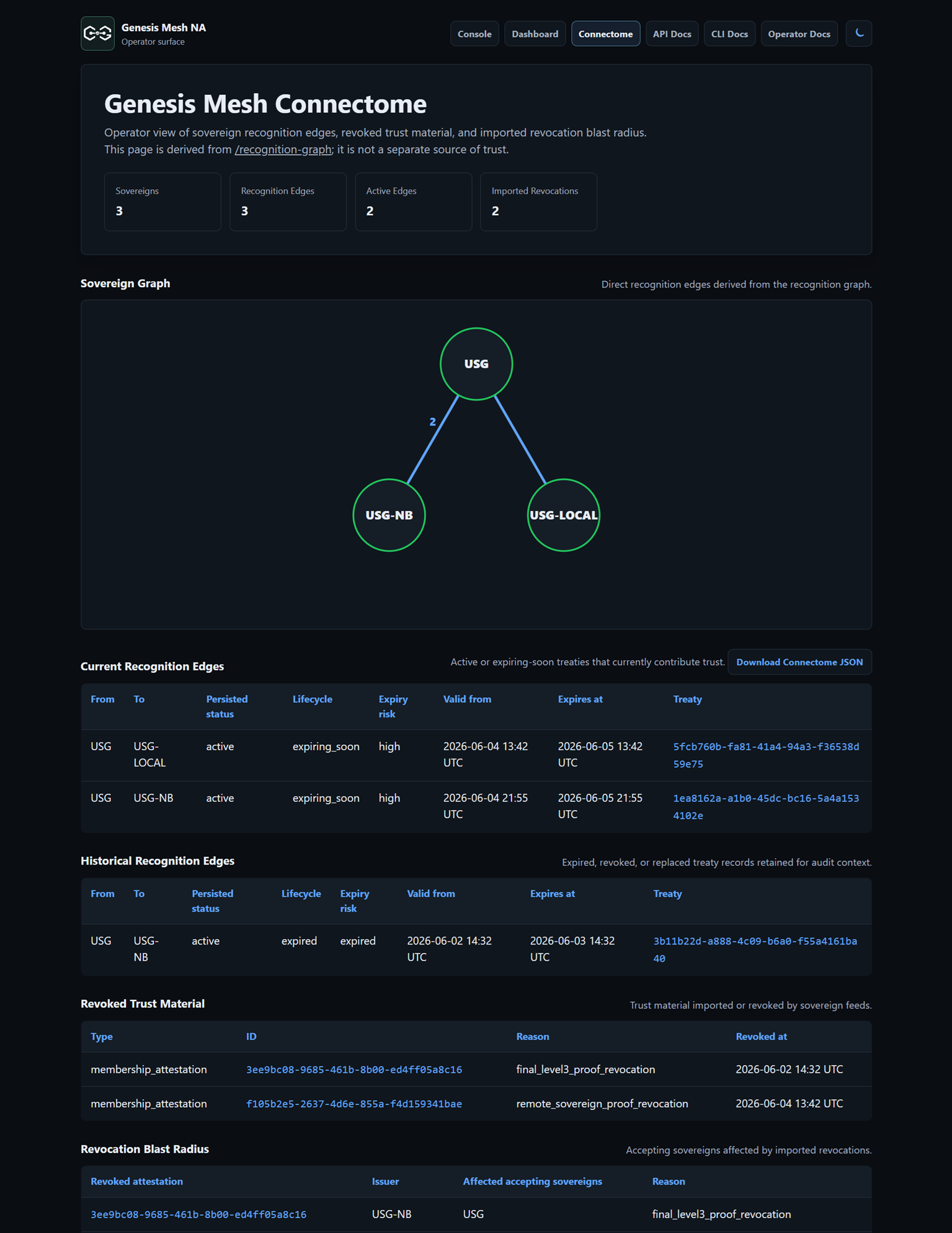
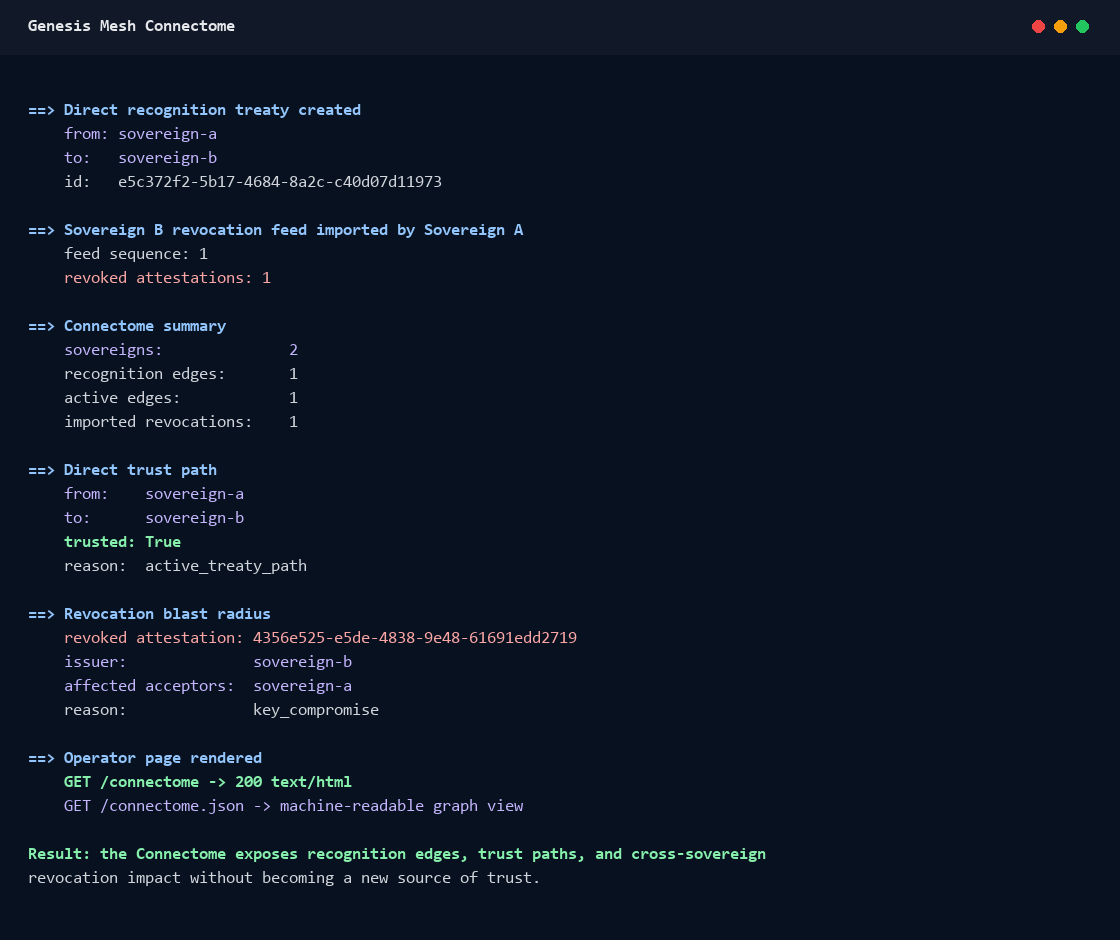
The screenshot above shows the deployed Network Authority view with multiple sovereigns, aggregated graph edges, split current and historical recognition tables, and readable treaty dates. The generated demo image below remains the repeatable local proof asset.
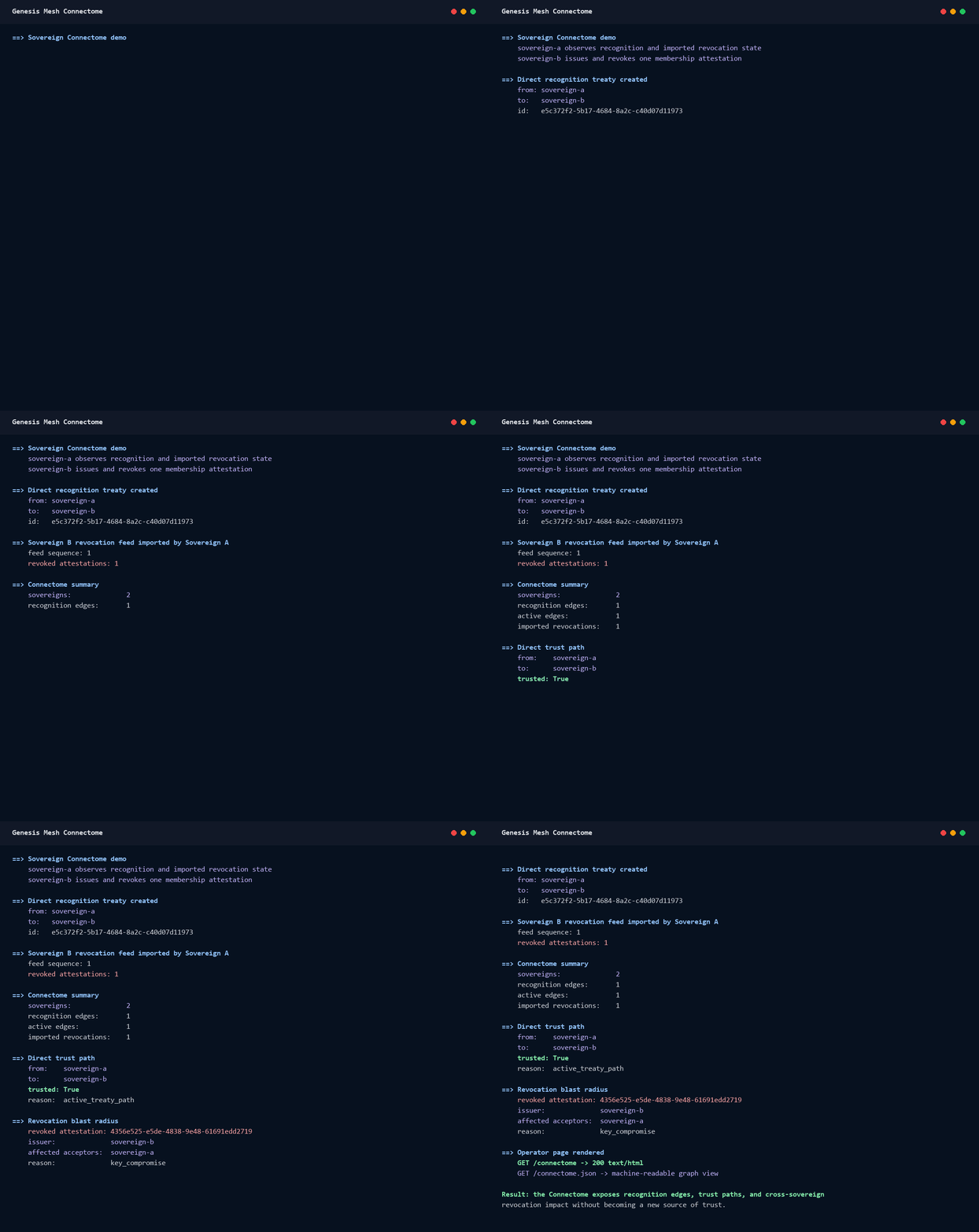
Animated execution:
Expected Proof
==> Connectome summary
    sovereigns:              2
    recognition edges:       1
    active edges:            1
    imported revocations:    1

==> Direct trust path
    from:    sovereign-a
    to:      sovereign-b
    trusted: True
    reason:  active_treaty_path

==> Revocation blast radius
    revoked attestation: <attestation-id>
    issuer:              sovereign-b
    affected acceptors:  sovereign-a
    reason:              key_compromise
Design Boundary
The Connectome is deliberately read-only. It visualizes and explains trust state, but the authoritative records remain signed treaties, signed attestations, imported signed revocation feeds, and the local Network Authority database.
See also
Example: Trust Atlas — relational view of who can do what, under what scope, with TrustEvidence overlay. Complements the Connectome’s edge-focused view.
Example: Trust Evidence — produce signed TrustEvidence records that Atlas can overlay on the recognition graph.