Example: Verifiable Logic Attestation
IBCTs (v0.32) attest what an agent can do: which capabilities, how many invocations, until when. They do not attest how the agent will reason: which model is executing, which system prompt it operates under, or which tools it has access to.
This gap is the hidden instruction exploit: a valid IBCT issued to agent A can be used by agent A running under a manipulated system prompt, a jailbroken model, or with additional undeclared tools. The authorization token is valid; the executing entity does not match what was authorized.
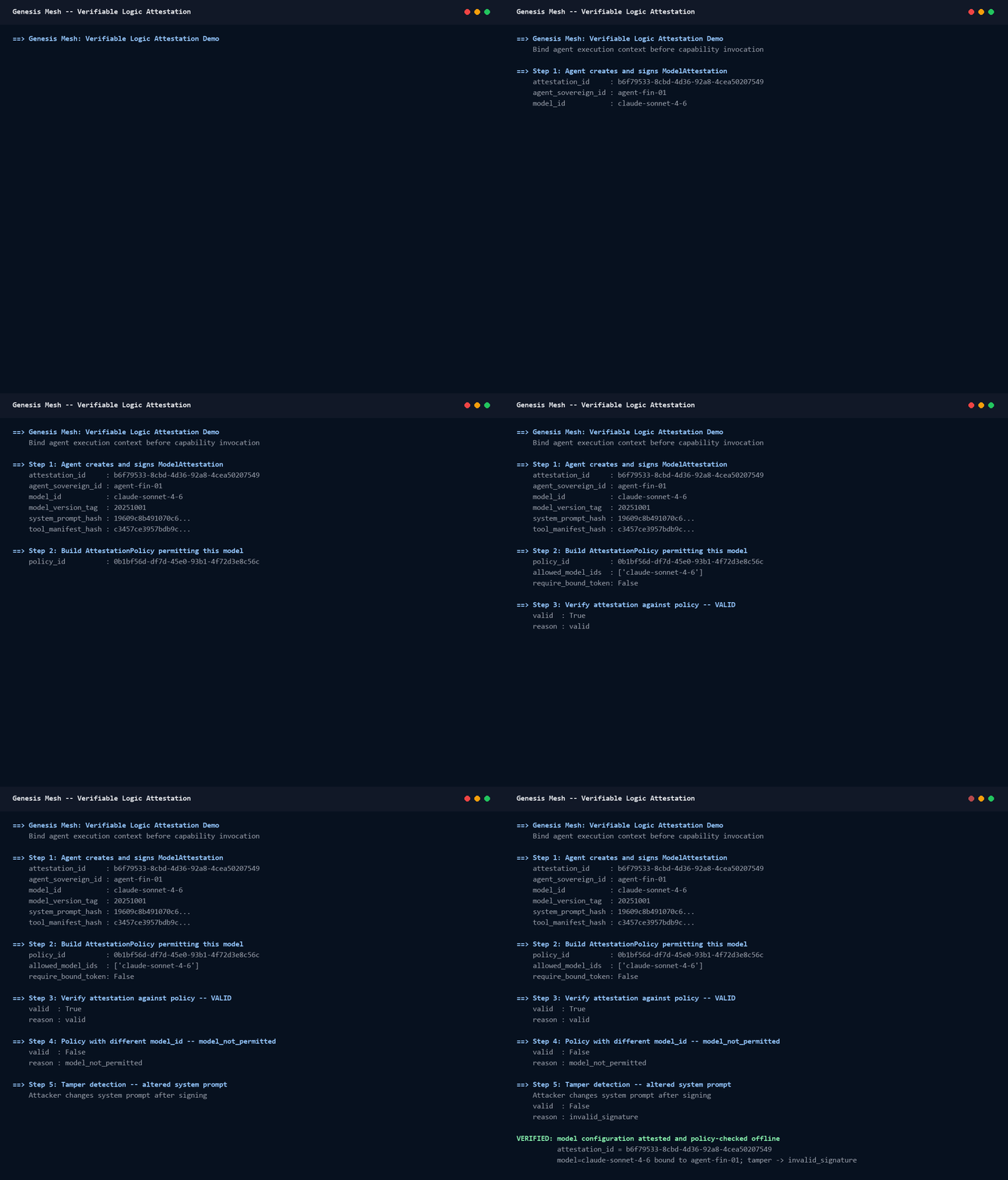
v0.40 introduces ModelAttestation: a signed record of the exact execution
context that a LogicAttestationGate validates before a capability executes.
Scope: Attestation covers declared configuration, not model outputs. We verify that the model’s configuration matches what was authorized — not what the model will produce.
What a ModelAttestation proves
model_id + model_version_tag: the exact model in use
system_prompt_hash: SHA-256 of the exact system prompt bytes — the prompt itself is never stored or transmitted
tool_manifest_hash: SHA-256 of the sorted tool list — order-independent, so two agents with the same tool set produce the same hash regardless of declaration order
agent_sovereign_id + signature: Ed25519-signed by the agent’s key; non-repudiable
expires_at: short-lived (default 300 s) — each capability invocation needs a fresh attestation
Prerequisites
Agent Ed25519 signing key (
agent.key)Operator
AttestationPolicyJSON specifying permitted model/prompt/tool combinationsAgent public key (for verification)
Step 1 — Operator creates an AttestationPolicy
genesis-mesh trust attest policy \
    --operator-sovereign operator-x \
    --allow-model claude-sonnet-4-6 \
    --allow-prompt-hash <sha256-of-authorized-prompt> \
    --valid-until 2027-01-01T00:00:00Z \
    --signing-key keys/operator.key \
    --output policy.json
Empty --allow-* lists mean “any value is permitted” for that dimension. To
restrict only model (and allow any prompt/tools):
genesis-mesh trust attest policy \
    --operator-sovereign operator-x \
    --allow-model claude-sonnet-4-6 \
    --valid-until 2027-01-01T00:00:00Z \
    --signing-key keys/operator.key \
    --output policy.json
Step 2 — Agent creates a ModelAttestation
Immediately before invoking a capability, the agent declares its execution context and signs it:
genesis-mesh trust attest create \
    --agent-sovereign agent-a \
    --model-id claude-sonnet-4-6 \
    --model-version 20251001 \
    --system-prompt-file prompts/system.txt \
    --tool-id tool_read \
    --tool-id tool_write \
    --signing-key keys/agent.key \
    --output attestation.json
Example output:
[OK] ModelAttestation 3b7e9f12-...
     Agent   : agent-a
     Model   : claude-sonnet-4-6 (20251001)
     Prompt  : a8f3c2e1d4b7a6f0...
     Tools   : 2 declared
     Expires : 2026-10-01T10:05:00+00:00
     Output  : attestation.json
Step 3 — Verify the attestation against policy
genesis-mesh trust attest verify \
    --attestation attestation.json \
    --policy policy.json \
    --public-key <agent-pub-b64> \
    --format human
Expected output (valid):
[OK] valid
  Attestation : 3b7e9f12-...
  Agent       : agent-a
  Model       : claude-sonnet-4-6
Exit code 0. If any check fails, exit code 1:
[FAIL] model_not_permitted
  Attestation : 3b7e9f12-...
  Agent       : agent-a
  Model       : unknown-model
Step 4 — Integrate LogicAttestationGate into the BoundaryEngine
Rather than running the CLI check manually, wire it into the authorization path:
from genesis_mesh.trust.logic_attestation import LogicAttestationGate

gate = LogicAttestationGate(
    attestation=agent_attestation,
    policy=operator_policy,
    agent_public_keys=[agent_pub_b64],
)
engine.add_gate(gate)

decision = engine.evaluate(context_record, agreed_terms)
# If attestation fails: decision.verdict == "deny"
# GateResult.gate_name == "logic_attestation"
# GateResult.detail   == reason code (e.g. "model_not_permitted")
Verification reason codes
Reason |
Condition |
|---|---|
|
All checks pass |
|
No signature on the attestation |
|
Signature does not match agent public key |
|
Current time > |
|
|
|
|
|
|
|
Policy requires |
Tool manifest hash
The tool_manifest_hash is computed from sorted(tool_ids), so two agents
with the same tool set produce the same hash regardless of declaration order:
from genesis_mesh.models.attestation import ToolManifest

manifest = ToolManifest(tool_ids=["tool_write", "tool_read"])
# manifest.manifest_hash == SHA-256 of '["tool_read","tool_write"]'
To pre-compute the hash for use in a policy:
python -c "
from genesis_mesh.models.attestation import ToolManifest
m = ToolManifest(tool_ids=['tool_read', 'tool_write'])
print(m.manifest_hash)
"
Token binding (optional)
If an AttestationPolicy has require_bound_token=True, the attestation must
include a token_id referencing a valid IBCT. This creates a cryptographic
link between the capability authorization and the execution context declaration:
genesis-mesh trust attest create \
    --agent-sovereign agent-a \
    --model-id claude-sonnet-4-6 \
    --model-version 20251001 \
    --system-prompt-file prompts/system.txt \
    --token-id <ibct-token-id> \
    --signing-key keys/agent.key \
    --output attestation.json
What logic attestation does NOT prove
That the model produced correct or safe outputs. Attestation covers declared configuration, not runtime behavior.
That the system prompt was not modified during execution. The hash is of the prompt at attestation time.
That the agent executed under exactly these tools. Attestation is a signed declaration — it is non-repudiable but not enforced by the runtime.
See also
CLI Reference —
genesis-mesh trust attestreferenceInvocation-Bound Capability Tokens (IBCTs) — the IBCT layer that attestation can bind to
Justification Proofs — signed gate trace per BoundaryDecision