Example: Multi-Agent Workflow
This example proves that Genesis Mesh can carry a cooperative agent workflow, not only direct request/response messages.
The workflow is intentionally small:
Researcher Agent
  -> Router Agent
      -> Knowledge Agent A
      -> Knowledge Agent B
The important part is not the knowledge backend. The important part is that
each participant has its own mesh identity, the request keeps the same
request_id across hops, and the final answer carries provenance that shows
which agent routed the work and which agent produced the answer.
        sequenceDiagram
    participant Researcher as Researcher agent
    participant Router as Router agent
    participant Sec as Knowledge agent A<br/>security
    participant Tx as Knowledge agent B<br/>transport

    Researcher->>Router: AgentRequest(question, request_id)
    Router->>Router: Select target from keyword rules
    Router->>Sec: Forwarded AgentRequest(trace += routed)
    Sec-->>Router: AgentResponse(provenance += answered)
    Router-->>Researcher: AgentResponse(provenance += returned)
    Researcher->>Researcher: Print answer + provenance

    Researcher->>Router: AgentRequest("what secures peer sessions?")
    Router->>Tx: Forwarded AgentRequest(trace += routed)
    Tx-->>Router: AgentResponse(provenance += answered)
    Router-->>Researcher: AgentResponse(provenance += returned)
What This Proves
One agent can route work to another agent.
The requester can keep provenance across multiple hops.
Each agent keeps its own mesh identity and join certificate.
Responses can be traced back to the agent that produced them.
Revocation still breaks the workflow safely because a revoked router or knowledge agent cannot keep participating in peer handshakes, routing, or certificate renewal.
Files
The runnable example lives under examples/agent-network/.
File |
Purpose |
|---|---|
|
JSON envelopes for agent requests, responses, trace, and provenance |
|
Long-running knowledge agent using |
|
Router agent that forwards requests to selected knowledge agents |
|
One-shot agent that sends a question and prints the answer |
|
Security-focused knowledge file |
|
Transport-focused knowledge file |
Run Locally
Start a local Network Authority first:
genesis-mesh init
genesis-mesh na start
Then start two knowledge agents. Each one gets its own invite token, certificate, key, and local config.
SEC_INVITE=$(genesis-mesh admin invite --role anchor)
TX_INVITE=$(genesis-mesh admin invite --role anchor)

python examples/agent-network/knowledge_base.py \
  --na http://127.0.0.1:8443 \
  --config ~/.gm-agents/kb-security/config.toml \
  --listen-port 7447 \
  --agent-id kb-security \
  --knowledge examples/agent-network/knowledge-security.json \
  --invite-token "$SEC_INVITE"

python examples/agent-network/knowledge_base.py \
  --na http://127.0.0.1:8443 \
  --config ~/.gm-agents/kb-transport/config.toml \
  --listen-port 7448 \
  --agent-id kb-transport \
  --knowledge examples/agent-network/knowledge-transport.json \
  --invite-token "$TX_INVITE"
Capture both knowledge-agent node public keys:
SEC_KEY=$(cat ~/.gm-agents/kb-security/node.cert.json | python3 -c "import json,sys; print(json.load(sys.stdin)['node_public_key'])")
TX_KEY=$(cat ~/.gm-agents/kb-transport/node.cert.json | python3 -c "import json,sys; print(json.load(sys.stdin)['node_public_key'])")
Start the router. It connects to both knowledge agents as peers and uses simple keyword rules to decide where each question should go.
ROUTER_INVITE=$(genesis-mesh admin invite --role anchor)

python examples/agent-network/router_agent.py \
  --na http://127.0.0.1:8443 \
  --config ~/.gm-agents/router/config.toml \
  --listen-port 7446 \
  --agent-id router-1 \
  --knowledge-agent "kb-security=$SEC_KEY" \
  --knowledge-agent "kb-transport=$TX_KEY" \
  --rule revocation=kb-security \
  --rule crl=kb-security \
  --rule noise=kb-transport \
  --rule routing=kb-transport \
  --peer ws://127.0.0.1:7447 \
  --peer ws://127.0.0.1:7448 \
  --invite-token "$ROUTER_INVITE"
Capture the router node public key:
ROUTER_KEY=$(cat ~/.gm-agents/router/node.cert.json | python3 -c "import json,sys; print(json.load(sys.stdin)['node_public_key'])")
Ask through the router:
RES_INVITE=$(genesis-mesh admin invite --role client)

python examples/agent-network/researcher.py \
  --na http://127.0.0.1:8443 \
  --config ~/.gm-agents/researcher/config.toml \
  --to-agent router-1 \
  --destination-key "$ROUTER_KEY" \
  --via ws://127.0.0.1:7446 \
  --invite-token "$RES_INVITE" \
  "how does revocation work?"
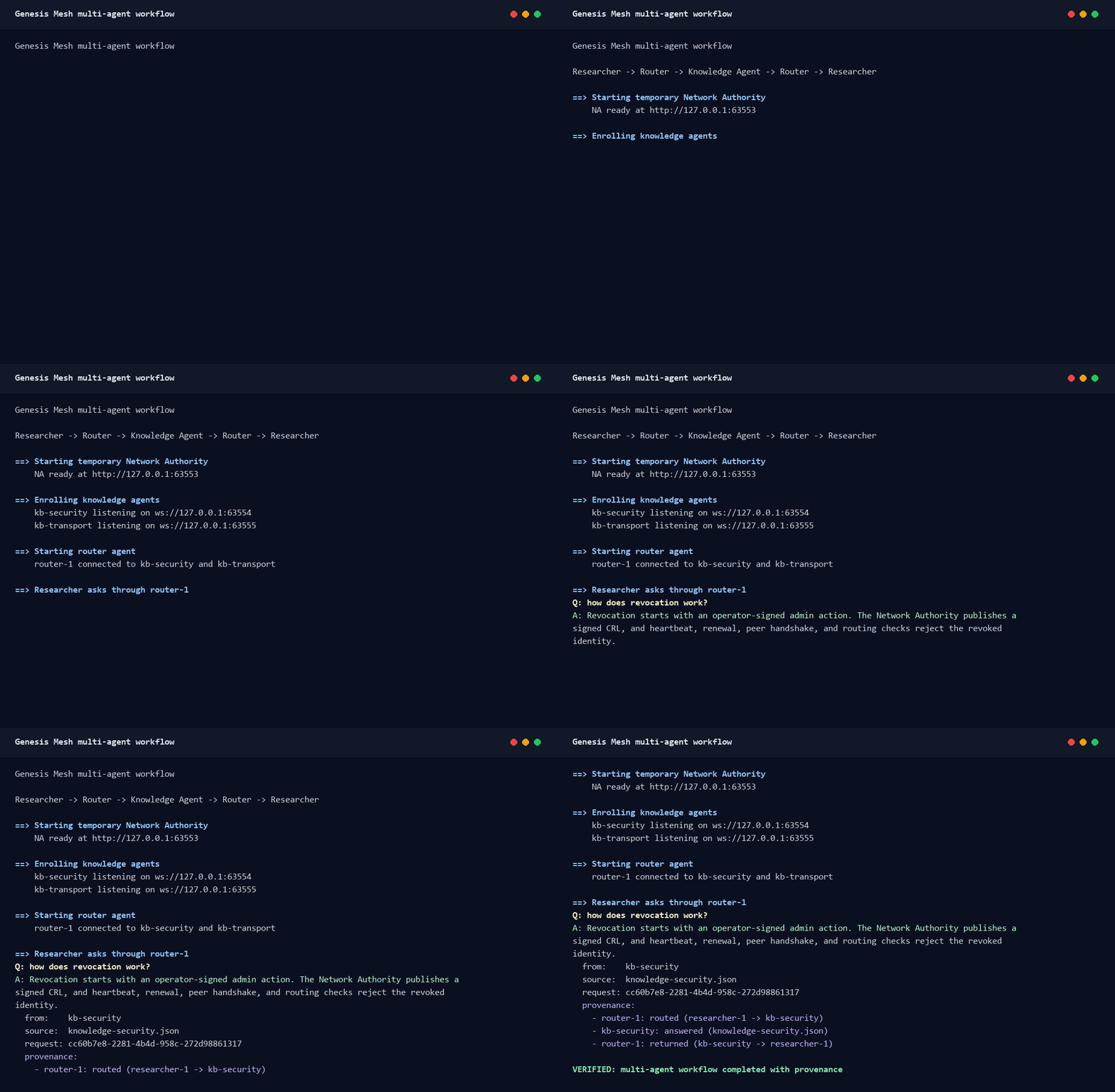
Expected output:
Q: how does revocation work?
A: Revocation starts with an operator-signed admin action. The Network Authority publishes a signed CRL, and heartbeat, renewal, peer handshake, and routing checks reject the revoked identity.
  from:    kb-security
  source:  knowledge-security.json
  request: <request-id>
  provenance:
    - router-1: routed (researcher-1 -> kb-security)
    - kb-security: answered (knowledge-security.json)
    - router-1: returned (kb-security -> researcher-1)
Ask a transport question and the same router sends the request to a different knowledge agent:
python examples/agent-network/researcher.py \
  --na http://127.0.0.1:8443 \
  --config ~/.gm-agents/researcher/config.toml \
  --to-agent router-1 \
  --destination-key "$ROUTER_KEY" \
  --via ws://127.0.0.1:7446 \
  "what secures peer sessions?"
Expected difference:
from:    kb-transport
source:  knowledge-transport.json
provenance:
  - router-1: routed (researcher-1 -> kb-transport)
  - kb-transport: answered (knowledge-transport.json)
  - router-1: returned (kb-transport -> researcher-1)
Revocation Behavior
The router workflow does not bypass the mesh trust model. If the operator revokes the router certificate, researchers cannot use it as the entry point. If the operator revokes a knowledge-agent certificate, the router cannot complete new trusted peer sessions or continue routing work to that identity.
The application code does not need its own trust broker for that behavior. Identity, authentication, CRL checks, and route rejection come from Genesis Mesh.
Verified Smoke Test
The implementation was verified with a local multi-process smoke test:
Start a temporary Network Authority.
Enroll
kb-security,kb-transport,router-1, andresearcher-1.Start two
knowledge_base.pyprocesses.Start
router_agent.pyconnected to both knowledge agents.Run
researcher.pyagainst the router.Assert the answer came from
kb-securityand provenance contains therouter-1 -> kb-security -> router-1path.
The focused regression tests are:
python -m pytest genesis_mesh\tests\test_agent_network_example.py -q
The GIF on this page is generated by the reproducible local recorder:
python docs\examples\assets\scripts\multi-agent-workflow-demo.py