Supply-Chain Trust Gate
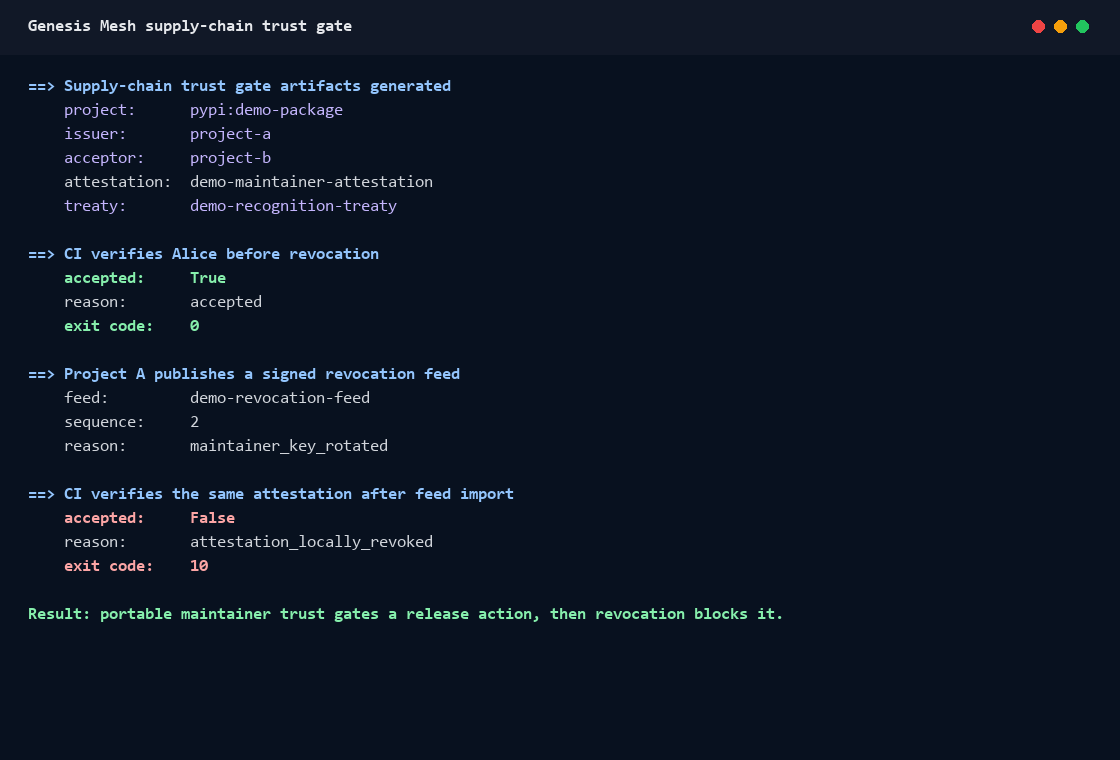
This example shows Genesis Mesh acting as a narrow CI/release gate. It does not replace a package registry, transparency log, or provenance system. It proves one smaller claim:
A project can accept or reject a maintainer action based on a portable attestation issued by another sovereign, and revocation of that attestation blocks the action without local re-enrollment.
Flow
        sequenceDiagram
    participant A as Project A Sovereign
    participant B as Project B Sovereign
    participant CI as CI / Release Gate

    A->>A: Issue Alice maintainer attestation
    B->>B: Sign treaty recognizing Project A maintainer role
    CI->>CI: Verify attestation + treaty
    CI-->>B: Allow release action
    A->>A: Revoke Alice attestation
    A-->>CI: Publish signed revocation feed
    CI->>CI: Verify same attestation + imported feed
    CI-->>B: Deny release action
Maintainer Claim Profile
The gate uses the existing MembershipAttestation primitive with a scoped
supply-chain profile:
{
  "profile": "genesis-mesh/supply-chain-maintainer/v1",
  "project_id": "pypi:demo-package",
  "repository": "https://github.com/example/demo-package",
  "delegated_role": "release-maintainer"
}
The attestation role must include:
role:supply-chain:release-maintainer
The accepting project signs a recognition treaty that allows that role from the issuing project sovereign.
Run The Demo
Generate the checked-in demo artifacts and PNG/GIF assets:
python docs\examples\assets\scripts\supply-chain-trust-gate-demo.py
Run the verifier before revocation:
$KEY = Get-Content docs\examples\assets\supply-chain-trust-gate\treaty-issuer-public-key.txt

genesis-mesh supply-chain verify `
  --attestation docs\examples\assets\supply-chain-trust-gate\maintainer-attestation.json `
  --treaty docs\examples\assets\supply-chain-trust-gate\recognition-treaty.json `
  --treaty-issuer-public-key $KEY `
  --project-id pypi:demo-package `
  --repository https://github.com/example/demo-package `
  --proof-bundle supply-chain-trust-gate-proof.json
Expected result:
ALLOW supply-chain trust gate
  reason:       accepted
  exit_code:    0
Run the same verifier with Project A’s signed revocation feed:
genesis-mesh supply-chain verify `
  --attestation docs\examples\assets\supply-chain-trust-gate\maintainer-attestation.json `
  --treaty docs\examples\assets\supply-chain-trust-gate\recognition-treaty.json `
  --treaty-issuer-public-key $KEY `
  --project-id pypi:demo-package `
  --repository https://github.com/example/demo-package `
  --revocation-feed docs\examples\assets\supply-chain-trust-gate\revocation-feed.json
Expected result:
DENY supply-chain trust gate
  reason:       attestation_locally_revoked
  exit_code:    10
The verifier prints only a compact audit summary. It does not print private keys, full request bodies, or signed payload bodies.
GitHub Actions Example
The sample workflow lives at
docs/examples/assets/github-actions/supply-chain-trust-gate.yml. It installs
Genesis Mesh, verifies the checked-in attestation and treaty, and writes a
redacted proof bundle suitable for CI artifacts.
What This Proves
A maintainer action can be authorized by a portable sovereign attestation.
A second project can recognize the issuing sovereign through a signed treaty.
The gate returns stable CI exit codes:
0for allow,10for deny,2for verifier errors.A signed revocation feed blocks the same maintainer without local re-enrollment.
The audit output explains the issuer, treaty, role, revocation reason, and trust path.
What This Does Not Claim
It does not replace Sigstore, SLSA, npm provenance, PyPI attestations, GitHub artifact attestations, or transparency logs.
It does not publish packages to a registry.
It does not provide package-manager policy plugins.
It does not prove all supply-chain security. It proves portable trust enforcement at one release gate.
See also: